
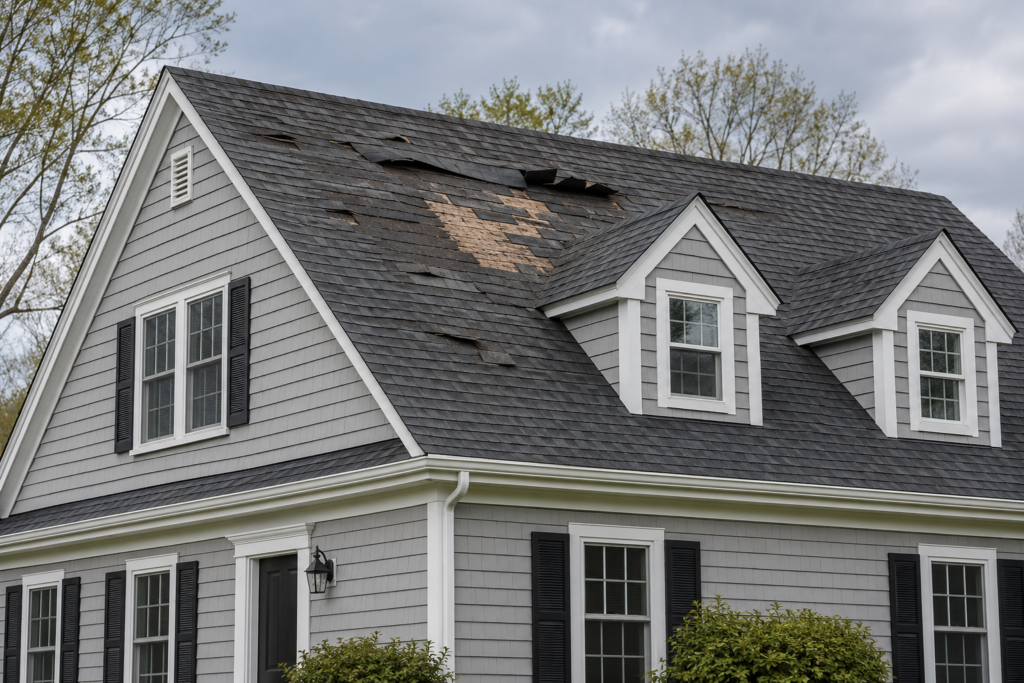
We get the same call every May. A homeowner walks out to the driveway after a windy night, looks up, and notices something off about the roof — a corner of a shingle flapping, a row that doesn’t sit flat, maybe a few dark patches where the granules used to be. Sometimes there’s a shingle on the lawn. Sometimes there isn’t, and the damage is still up there.
Wind damage on asphalt shingles is the most common roof issue we see across Southern NH between April and June. The good news: most of it is identifiable from the ground if you know what you’re looking for. The bad news: a lot of it doesn’t look like damage to an untrained eye, which is how small problems become five-figure problems two winters later. This guide covers what wind actually does to asphalt shingles, the four damage patterns we see most often after Seacoast and Lakes Region storms, and what we’d tell you to do depending on what you find.
How Wind Actually Damages Asphalt Shingles
Asphalt shingles are held down by two things: the nails, and the self-sealing strip of asphalt adhesive on the underside of each shingle that bonds it to the course below. That sealant cures in the sun over the first few warm days after installation. Once it sets, it forms a watertight bond — until something breaks it.
Wind doesn’t peel shingles off the way most people picture it. What happens is more subtle. A gust gets under the leading edge of a shingle, lifts it just enough to break the seal, then drops it back down. From the ground, nothing looks wrong. The shingle is still there, still flat, still nailed in. But the seal is gone. The next time wind catches that edge — or the next time water gets driven sideways under it — there’s nothing stopping it.
That’s why we always tell homeowners: missing shingles aren’t the worst-case scenario. Missing shingles are obvious. It’s the shingles that look fine but aren’t sealed anymore that quietly leak for months before anyone notices.
The Four Wind Damage Patterns We See Most
1. Lifted or unsealed shingles
This is the sneaky one. From the ground, the shingle looks normal. Up close on a ladder, you can slide a putty knife under the bottom edge with no resistance — the sealant strip is broken. We see this most on roofs over 10 years old, where the adhesive has gotten brittle, and on the windward sides of homes — the south and southwest exposures in most of NH.
2. Creased shingles
When wind lifts a shingle hard enough to fold it back on itself before dropping it, you get a horizontal crease across the face. That crease is a fracture in the mat — the fiberglass layer that holds the shingle together. Even if the shingle re-seals after the storm, that crack will leak. Creased shingles can’t be repaired in place. They have to come out.
3. Missing tabs or full shingles
The obvious one. You’ll see bare black or gray squares on the roof where the underlayment or felt is exposed. On a 3-tab shingle, you might lose a single tab. On an architectural shingle, you usually lose a full strip. Either way, the deck below is exposed to weather until it’s fixed — and once water gets in, it spreads laterally through the underlayment far beyond the visible gap.
4. Granule loss in storm streaks
After a hard wind-driven rain, look at the bottom of your downspouts. If there’s a heavy pile of black sand-like grit there, your shingles shed granules during the storm. Some granule loss is normal — especially on a new roof or an old one. What you don’t want is granule loss in defined streaks down the roof, or shiny black spots where the asphalt base shows through. Those are wear points that will become leaks.
Quick Tip
The day after a windy night, take five minutes and walk the perimeter of your house with binoculars or a phone camera with zoom. Look at the courses near the ridge, the rakes (edges), and anywhere a wall meets the roof. Photograph anything that looks lifted, bent, or out of place — even if you’re not sure. Pictures from the same day as the storm are gold for an honest contractor evaluation later.
What Counts as “Storm Wind” in New Hampshire
Shingle manufacturers rate products for wind resistance — usually 110 mph for standard architectural shingles, up to 130 mph for high-wind versions. Those numbers refer to brand-new, properly nailed, fully sealed shingles in lab conditions. They are not what your 14-year-old roof can actually take.
In the real world, we see seal failures starting around 50–55 mph sustained gusts on roofs over 10 years old. That’s a normal spring nor’easter on the Seacoast. Lakes Region homes near open water — Winnipesaukee, Winnisquam, Squam — take longer fetches across the lake and routinely see gust events in the 60–70 mph range. North Shore Massachusetts coastal homes deal with similar conditions plus salt-air exposure that accelerates sealant breakdown.
The point: you don’t need a hurricane to lose seal integrity. You need a normal April storm, an older roof, and the right (wrong) wind direction.
How to Inspect Your Roof From the Ground
You don’t need to climb up there. In fact, please don’t — asphalt roofs are slippery when wet, brittle when cold, and walking on damaged shingles makes the damage worse. Here’s a ground-level inspection that actually works:
- Walk the perimeter twice. Once looking up at the roof faces, once looking down at the ground for shingle debris, granule piles, or pieces of metal flashing.
- Use the gable angles. The corners of your house give you the best angle to see across each roof slope. From there you can spot any shingle that’s not lying flat.
- Photograph everything that looks off. A 10x zoom on a modern phone is enough to see crease lines, missing tabs, and granule streaks from the ground.
- Check the attic. Daylight where there shouldn’t be daylight, or fresh water staining on the underside of the sheathing, tells you whether anything got through.
- Look at neighbors. If three houses on your street have shingles on the lawn and yours doesn’t, that doesn’t mean your roof is fine. It means the wind direction favored a different slope. Inspect anyway.
What’s Repairable vs. What Needs Replacement
This is the question that actually matters. The honest answer depends on three things: how old the roof is, how widespread the damage is, and whether you can match the existing shingle.
Likely repairable
- Roof under 12 years old with damage limited to a localized area (one slope, less than 20–30 shingles affected)
- A handful of lifted shingles that can be re-sealed with roofing cement under each tab
- A few missing tabs on a 3-tab roof where original shingles are still manufactured
- Isolated wind damage with no creasing on adjacent shingles
Likely needs a full replacement
- Roof over 18 years old with any wind damage — the rest of the roof is at the end of its life regardless
- Widespread creasing across multiple slopes — the seal strips are failing systemically
- Discontinued shingle product that can’t be matched without a noticeable patch
- Damage that extends to the underlayment or sheathing
- Multiple prior repairs that haven’t held
We’ve turned down repair jobs that homeowners insisted on, because patching a roof that’s three storms away from total failure is bad money. We’ve also done $400 shingle replacements on six-year-old roofs that didn’t need anything more. The right answer is the one that’s honest about the condition of the whole roof, not just the visible damage.
The Mistake We See Most Often
Homeowners wait. The roof “doesn’t look that bad” from the ground, there’s no active leak inside, and life moves on. Then July hits with a thunderstorm that puts an inch of rain down sideways in 20 minutes, water runs under the unsealed shingles, finds the gap, and now you’ve got staining on the bedroom ceiling.
The lifted shingles after a May storm are a free warning. Treat them like one. The repair window between when wind breaks the seal and when water finds the breach is usually weeks to a few months — not years.
Wind Damage by Region: Where We See Different Patterns
Seacoast NH (Stratham, Portsmouth, Hampton, Rye, Exeter): Salt air accelerates sealant breakdown by 2–3 years compared to inland roofs. We see more unsealed-shingle failures here on roofs in the 8–12 year range than anywhere else in our service area. Eastern exposures take the brunt of nor’easter wind.
Lakes Region NH (Laconia, Meredith, Wolfeboro, Gilford, Belmont): Long open-water fetches on Winnipesaukee, Winnisquam, and Squam generate higher gust events than the geography suggests. We see more creased shingles here — full-strip lifts on the windward sides of waterfront and ridge-top homes.
Inland Southern NH (Newmarket, Durham, Dover): Tree fall is the bigger wind risk than direct shingle damage. We get more calls for branch impact, debris-cut shingles, and flashing damage from limbs hitting eaves.
Northern MA Coast (Newburyport, Amesbury, Newbury): Same salt-air issue as the NH Seacoast, plus a longer coastal exposure. Roofs here often need replacement at 18–20 years rather than the 22–25 we see inland.
Southern ME (Kittery, York, South Berwick, Eliot): Coastal patterns mirror the NH Seacoast. We see more granule loss after spring storms here, particularly on west-facing slopes that catch afternoon storm wind.
What to Do If You Think You Have Wind Damage
Three steps, in this order:
- Document it now. Date-stamped photos from the ground, with as much detail as your phone camera will give you. If you have an attic, photograph the underside of the roof deck too.
- Stop the bleeding if there’s an active leak. A tarp over the affected area, weighted with sandbags or 2x4s — never nailed through the roof. If you’re not comfortable on a roof, call us and we’ll tarp it as a temporary measure.
- Get a real inspection. Not a drone flyover, not a satellite image, not a guy in a pickup truck who knocked on your door the morning after the storm. An actual contractor on the roof, checking the seal integrity by hand, walking the slopes, looking under the lifted edges.
We do hands-on inspections across Southern NH, the Lakes Region, North Shore MA, and Southern ME. No drones, no drive-by estimates, no high-pressure pitch. If you’ve got damage, we’ll show you the photos and walk you through what needs to happen. If you don’t, we’ll tell you that too.
Wind Damage FAQs
How much wind does it take to damage asphalt shingles in NH?
On a new, properly installed roof, you need sustained gusts above 90 mph to physically lift shingles. But on a roof over 10 years old where the sealant has aged, we see seal failures starting around 50–55 mph — well within the range of a normal spring nor’easter. The age of the roof matters more than the wind speed.
Can I tell from inside the house if my roof has wind damage?
Sometimes. Check your attic with a flashlight. Look for daylight at the ridge or eaves where there shouldn’t be any, fresh water staining on the sheathing, or damp insulation. Active leaks inside the living space mean water has already found its way through — that’s an emergency, not a “wait and see.”
Is wind damage covered under my shingle warranty?
Most manufacturer warranties cover wind damage up to a rated speed (usually 110 mph for architectural shingles), but only on a roof that’s been properly installed with the correct nail pattern and starter strip. After a wind event, the warranty doesn’t typically cover repairs — it covers full replacement of defective shingles. For storm damage, you’re usually looking at a contractor repair rather than a warranty claim.
How long after a storm do I have to deal with wind damage?
The shingle damage itself isn’t a leak yet. The clock starts when the next rain event hits. In NH, that’s usually within two to three weeks of any wind event. We’d say get a contractor on the roof inside of three weeks — sooner if the damage is on a slope facing prevailing weather.
Do you offer free wind damage inspections in NH?
Yes — we do free hands-on inspections across our entire service area in Southern NH, the Lakes Region, North Shore MA, and Southern ME. We’re on the roof, not flying a drone over it. You get photos of everything we find and a straight answer on whether it’s repair, replace, or no action needed. Call 603-219-1523 or book online.
Can missing shingles be repaired, or does the whole roof need replacing?
If the rest of the roof is in good shape and the shingle product is still manufactured, a few missing shingles can absolutely be repaired. The matching is the hard part — sun fading and granule wear mean a brand-new shingle next to a 10-year-old one will be visible. We can usually pull replacement shingles from a less-visible slope and patch the prominent area if matching becomes a problem.
What does it cost to repair wind damage in NH?
Small repairs — a handful of shingles, some re-sealing, minor flashing fixes — generally run $400 to $1,200. Larger repairs affecting a full slope or involving underlayment work can run $1,800 to $4,500. If the damage is widespread and the roof is older, a full replacement becomes the more honest answer. We give written estimates so you can compare.
Should I tarp my roof myself after a storm?
Only if you’re experienced on a roof and conditions are dry. Wet asphalt is dangerously slippery, and nailing a tarp down through shingles creates more holes than it fixes. If you tarp, weight it down with sandbags or boards across the ridge — don’t fasten through the field of the roof. Honestly, call us first. We tarp roofs as a free emergency service for clients in our area.
Think Your Roof Took Wind Damage? Let’s Take a Look.
We’re Owens Corning Preferred Contractors doing hands-on roof inspections across Southern NH, the Lakes Region, North Shore MA, and Southern ME. No drones, no drive-bys, no high-pressure sales — just an honest look at what you’ve got and a straight answer on what (if anything) needs to happen next.
✓ Owens Corning Preferred Contractor ✓ BBB A+ Rated ✓ Google Guaranteed