
Roof Flashing 101: Why It Causes Most Roof Leaks on NH Homes
Step flashing, chimney pans, valley metal, pipe boots — the unglamorous strips of metal that decide whether your roof leaks or doesn’t. Here’s what every NH homeowner should know.
Most homeowners think a leaking roof means bad shingles. Nine times out of ten, the shingles are fine. It’s the flashing — those thin strips of metal tucked around your chimney, valleys, walls, and vent pipes — that’s giving up. We’ve torn off enough roofs across Stratham, Portsmouth, Laconia, and Newburyport to say that with confidence. The shingles outlive the flashing on a lot of older homes, especially when the previous roofer cut a corner and reused old metal on a re-roof.
This is the guide we wish every homeowner had before they signed a contract. We’ll walk you through every type of roof flashing, where each one lives on your roof, why each one fails, and what good installation actually looks like. By the end you’ll know enough to spot a hack job from the ground and ask the right questions before you sign anything.
Quick Answer
Roof flashing is thin metal installed at roof joints, edges, and penetrations to channel water away from vulnerable seams. It’s the most common source of roof leaks in NH — usually because it was installed incorrectly, reused during a re-roof, or simply reached the end of its lifespan (typically 20-35 years inland, less on the coast).
What is roof flashing, exactly?
Roof flashing is sheet metal — typically aluminum, galvanized steel, or copper — bent and shaped to seal the seams of your roof where shingles alone can’t keep water out. Anywhere your roof changes direction or something pokes through it, flashing is what makes it watertight.
Shingles do a fine job shedding water down a flat plane. They fail at corners, transitions, and anything sticking up through the deck. That’s why every spot where the roof meets a wall, every valley between two roof planes, and every penetration — chimney, skylight, plumbing vent, attic exhaust — needs flashing.
The trades have been doing this for over a century. The materials have improved (aluminum replaced lead, painted steel replaced bare galv), but the principle hasn’t changed. Water runs downhill. Flashing forces it to keep running downhill — over the shingles, into the gutter, away from your house.
The seven types of flashing on a typical NH roof
You don’t need to memorize every term. But knowing what’s up there helps you understand what a contractor is talking about — and helps you spot when one’s skipping something they shouldn’t.
1. Step flashing
Used where a sloped roof meets a vertical wall (think the side of a dormer, or a roof tied into a second-story wall). It’s installed as individual L-shaped pieces, one per shingle course, woven into the shingles as the roofer works up the slope. Done right, you should barely see it. Done wrong — usually one long continuous strip caulked into place — and it’ll leak within five years.
2. Counterflashing
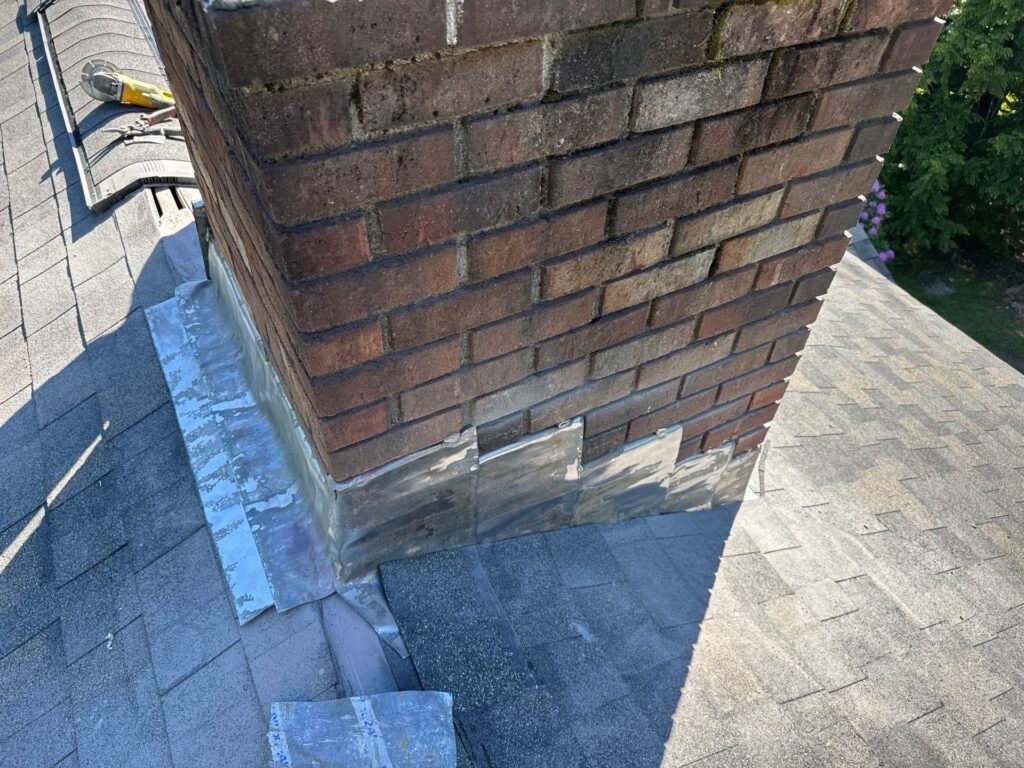
The partner to step flashing on masonry walls and chimneys. It’s a second piece of metal cut into the mortar joint and bent down to cover the top edge of the step flashing. This is what keeps water from running behind the step flashing. On a chimney, you’ll see a horizontal kerf cut into the mortar with the metal tucked in and sealed. If you see surface-mounted L-metal nailed to brick with a bead of caulk on top, that’s not counterflashing — that’s a Band-Aid.
3. Valley flashing
Lives in the V-shape where two roof planes meet. There are two methods — open valley (a visible metal channel running down the V) and closed valley (shingles woven across or cut along a centerline). Open valleys with W-shaped aluminum or copper handle our heavy snow load better. The compressed snow and ice that sits in valleys all winter is brutal on a closed valley, and we see more failures there in the Lakes Region than anywhere else on a roof.
4. Drip edge
Aluminum L-trim that runs along the eaves (bottom edge) and rakes (gabled side edges) of the roof. It does two jobs — it pushes water past the fascia and into the gutter instead of behind it, and it covers the raw edge of the roof sheathing so wind-driven rain can’t soak in. Code in New Hampshire requires it. We still see plenty of older roofs without any drip edge at all, and the rotted fascia boards underneath tell the story.
5. Chimney flashing (pan and saddle)
The most failure-prone spot on most roofs. A proper chimney flash uses base flashing across the front, step flashing up both sides, and either a cricket (a small peaked structure) or a saddle on the high side to divert water around the chimney instead of letting it pile up behind. Every piece gets counterflashed into the mortar. A complete chimney re-flash is a half-day to full-day job and runs $800-$2,500. Skipping it during a re-roof to save the homeowner money is the cheapest way to guarantee a leak in three years.
6. Pipe boots (vent flashing)
The rubber-gasket flashings that wrap around plumbing vent pipes. The flange is metal, but the seal is a neoprene or EPDM rubber collar. Sun and freeze-thaw destroy the rubber long before the metal goes. Pipe boots are the most underrated cause of attic leaks we find. A $40 part fails, water trickles down the pipe into the wall cavity, and the homeowner doesn’t notice until ceiling drywall starts to stain. We replace every pipe boot during a re-roof — no exceptions.
7. Kickout flashing
The small angled diverter installed where a roof edge dead-ends into a sidewall (like over a garage that ties into the house). Without it, water sheets off the roof, runs straight down the wall behind the siding, and rots the sheathing — for years, invisibly. Missing kickouts are the source of some of the worst wall-rot jobs we’ve ever opened up. If your home was built before 2000 or by a builder cutting corners, there’s a decent chance yours is missing.
Why does roof flashing leak?
Most flashing leaks come from three causes: it was installed wrong (caulk used instead of properly woven step flashing), it’s corroded through after 20-35 years of weather, or — most commonly on NH re-roofs — the old flashing was reused instead of replaced when the shingles were swapped out.
Let’s break that down further, because the reasons matter when you’re deciding what to do about it.
Reused flashing on a re-roof
This is the #1 thing we find on roofs that are 8-12 years old and already leaking. The previous roofer either didn’t want to pay for new metal or didn’t want the labor of a proper chimney re-flash. They tore off the old shingles, slid the new ones underneath the existing flashing, and called it good. Five years later the flashing has corroded a bit more, a few nail holes that were “good enough” have worn open, and the homeowner is calling someone else. We see it constantly. Always replace flashing when the shingles are replaced.
Caulk instead of metalwork
Caulk is a temporary patch. UV breaks it down, freeze-thaw cycles open hairline cracks, and within two seasons it’s leaking again. We’ve seen entire chimneys “flashed” with nothing but a bead of urethane caulk smeared along the brick. Looks like work was done. It’s not.
End of service life
Aluminum flashing has a real shelf life. Inland — Concord, Manchester, Laconia, Wolfeboro — you’ll get 25-35 years out of it. Along the Seacoast and on the coastal MA/ME line, salt air pits aluminum faster, and 15-25 years is more realistic. Galvanized steel flashing on older homes can rust through within 15 years if the zinc coating has been compromised. Copper outlives the building.
Improper material pairing
Aluminum touching copper causes galvanic corrosion — the aluminum corrodes rapidly. We’ve cut apart 8-year-old aluminum step flashing that touched a copper gutter and crumbled in our hands. The materials need to match or be properly isolated.
What good flashing installation looks like
If you’re standing in your yard looking up at a finished roof, here’s what you want to see:
- Step flashing visible as discrete pieces tucked behind each shingle course along a sidewall — never one long strip.
- Counterflashing cut into mortar joints on chimney sides, not surface-nailed to the brick.
- A cricket or saddle on the upslope side of any chimney wider than 30 inches.
- Open valleys with W-style metal running down — or, at minimum, valleys covered with ice and water shield before the shingles go on.
- Drip edge under the underlayment at the eaves, over the underlayment at the rakes (that’s the manufacturer-spec install).
- New pipe boots in matching color, sitting flat and tight around the vent pipes.
- Kickout flashing at every roof-to-sidewall termination.
- No visible caulk doing any structural sealing work. Caulk is for cosmetic edges, not for holding water out.
Before you sign a roofing contract, ask: “Will all flashing be replaced with new material, including chimney counterflashing cut into the mortar joints?” If the answer is anything other than yes, get another quote. A proper flashing replacement adds $400-$1,500 to the project on most homes. It saves $5,000-$15,000 in rot repair over the next decade.
How much does flashing replacement cost?
If you need flashing repaired as a standalone job (not as part of a full re-roof), here’s what we typically see in 2026 for NH, MA, and ME projects:
| Repair Type | Typical Cost Range | What’s Included |
|---|---|---|
| Single pipe boot replacement | $300 – $600 | New boot, sealed, matched in color |
| Section of step flashing | $400 – $800 | Remove shingles, install new step flash, re-shingle |
| Valley metal — single valley | $500 – $1,200 | New W-valley, ice & water shield, re-shingled cuts |
| Full chimney re-flash | $800 – $2,500 | Base, step, counterflashing cut into mortar, optional cricket |
| Drip edge — full perimeter | $600 – $1,500 | Aluminum drip edge, eaves and rakes, painted to match |
| Kickout flashing — per location | $200 – $450 | Custom-bent piece, integrated with siding |
If you’re getting a full roof replacement, flashing should be baked into the per-square pricing — never an upsell. Any quote that lists “chimney flashing” as a separate $1,800 add-on after the fact is one to question.
Regional flashing concerns across our service area
Where you live changes which flashing problems hit first.
Salt-Air Pitting
Aluminum flashing in Portsmouth, Rye, Hampton, and New Castle pits faster. We spec painted aluminum or copper in coastal applications and replace step flashing during every re-roof — 15-25 year lifespan, not 30.
Valley & Ice Damming
Heavy snow loads in Laconia, Meredith, Wolfeboro, and Gilford concentrate in valleys for months. Open W-valleys with ice and water shield extending 3 feet up either plane is the standard we install. Closed valleys are a callback waiting to happen.
Coastal Wind + Storms
Newburyport, Amesbury, and Haverhill see coastal nor’easters that pry up loose drip edge and lift unsealed step flashing. Hidden fasteners and properly nailed (not caulk-only) flashing matter more here than 30 miles inland.
Freeze-Thaw on Mortar
Kittery, York, and South Berwick chimneys take a beating from freeze-thaw on mortar joints. Counterflashing pulls loose when mortar deteriorates. We coordinate masonry repointing with the re-flash so the counterflashing has solid mortar to anchor into.
The DIY question — and our honest answer
Can you replace a pipe boot yourself if you’re comfortable on a ladder? Sure. The part costs $15-$40 at any supply house, the install takes 20 minutes, and the consequences of a slightly imperfect job are pretty contained.
Chimney flashing, valley metal, step flashing tying into siding? Don’t. Not because we want the work — there are enough leaks in Southern NH and the Lakes Region to keep us busy through 2027 — but because the consequences of getting it wrong are invisible for years. By the time you see a stain on a ceiling, the sheathing underneath has been wet for two winters and the rot is structural. The cost to repair that delta is 10-20x what hiring it out would’ve been.
Roofing is one of those trades where the labor cost feels high until you see what we open up underneath. Then it makes sense.
When should I inspect my flashing?
Twice a year is the right rhythm — spring (after winter has had its way with everything) and fall (before snow flies). You don’t need to climb on the roof. Walk around with binoculars. Look for:
- Lifted, curled, or visibly missing metal anywhere around the chimney
- Cracked caulk lines along step flashing or chimney bases
- Rust streaks running down siding below a flashing transition
- Pipe boot collars that are split, sagging, or pulling away from the pipe
- Dark staining on ceilings or top-floor walls — especially below where you know a vent pipe or chimney is
- Missing or rotted fascia/soffit below where drip edge should be
If you see any of these, get someone up there. We do hands-on inspections — actual roof walks, not drone flyovers — across our entire service area. A flashing fix at year 12 saves a full deck replacement at year 18.
Roof Flashing FAQ
What is roof flashing?
Roof flashing is thin metal — usually aluminum, galvanized steel, or copper — installed at the joints, edges, and penetrations of your roof to redirect water away from those vulnerable spots. Anywhere shingles meet a wall, chimney, skylight, vent pipe, or another roof plane, flashing is what keeps water out.
Why does roof flashing leak?
Flashing leaks for three main reasons: it was installed wrong (caulk used instead of properly woven step flashing), it’s reached the end of its lifespan and corroded through, or a re-roof crew reused old flashing instead of replacing it with new metal. Reused chimney flashing is the single most common leak we find on NH homes.
How long does roof flashing last?
Aluminum flashing typically lasts 20 to 35 years in inland NH and 15 to 25 years near the coast where salt air accelerates pitting. Galvanized steel can rust within 15 years if not painted. Copper flashing can last 70+ years and outlives the roof it’s protecting. The flashing should always be replaced when shingles are replaced — never reused.
How much does it cost to replace roof flashing in NH?
Replacing flashing as a standalone repair runs $300 to $600 for a simple pipe boot, $400 to $900 for valley metal on a single valley, and $800 to $2,500 for a full chimney re-flash including counterflashing cut into the mortar joints. Full replacement during a re-roof is included in the per-square pricing — there should never be a separate line item if your contractor is doing it right.
Can I just caulk a flashing leak?
Caulk is a temporary patch, not a repair. It buys you a season or two, then cracks from UV exposure and freeze-thaw. Real flashing repair means lifting shingles, removing the old metal, and installing new step or counterflashing properly woven into the courses. If you see a contractor solve a flashing leak with a tube of caulk, that’s a red flag.
What is kickout flashing and why does it matter?
Kickout flashing is a small angled piece installed where a roof edge meets a sidewall — it diverts water off the roof and into the gutter instead of behind the siding. It’s commonly missed on older NH homes and on builds from contractors who don’t know better. The damage from a missing kickout is invisible from outside until siding rots and the wall sheathing starts crumbling.
Does insurance cover flashing leaks?
Insurance generally covers sudden damage from a storm event, not gradual leaks from old or improperly installed flashing. If your flashing has been quietly leaking for years and you discover rotted sheathing during a re-roof, that’s a maintenance issue and falls on the homeowner. We do retail repair work — not insurance claim chasing — and we’ll tell you straight which category your damage falls into.
Worried About Your Flashing? Let’s Take a Look.
We’re Owens Corning Preferred contractors who actually walk your roof — no drones, no drive-by guesses. If your flashing is reaching end of life or your last roofer cut corners, we’ll show you exactly what’s happening and what it’ll cost to fix.