
The strip running along the very peak of your roof — that’s the ridge vent, and it’s the single most important piece of the attic ventilation system. The problem? Half the ridge vents we tear off when we’re doing a roof replacement in NH are the cheap rolled-mesh kind, and they were causing problems the whole time the homeowner had no idea about. This ridge vent comparison walks through why that matters and what the right ridge vent actually looks like.
If you’ve gotten roofing quotes and one contractor’s bid is $800 cheaper than another, this is one of the places that gap is hiding. We’ll show you the difference between the rolled mesh “Cobra-style” vent and an externally baffled, filtered rigid ridge vent — and why the second one is the only kind we put on a Compass-installed roof.
What a Ridge Vent Actually Does
Quick refresher: hot, moist air rises into your attic. It needs to get out. If it doesn’t, you get trapped heat in summer (which cooks shingles from underneath and drives up cooling bills) and trapped moisture in winter (which condenses on the underside of the roof deck and rots sheathing, ruins insulation, and eventually shows up as mold). The ridge vent is the exhaust. Cool, dry air comes in through soffit vents at the eaves, rises through the attic, and exits at the peak. That’s the loop.
For that loop to work, the ridge vent has to do three things at once:
- Move enough air — measured in Net Free Area, or NFA, in square inches per linear foot
- Block weather — wind-driven rain, snow, insects, and debris should stay outside
- Hold its shape — under the weight of cap shingles, snow load, and time
A cheap rolled-mesh vent fails at all three. A real ridge vent doesn’t. Here’s the breakdown.
The “Cobra Roll” Problem
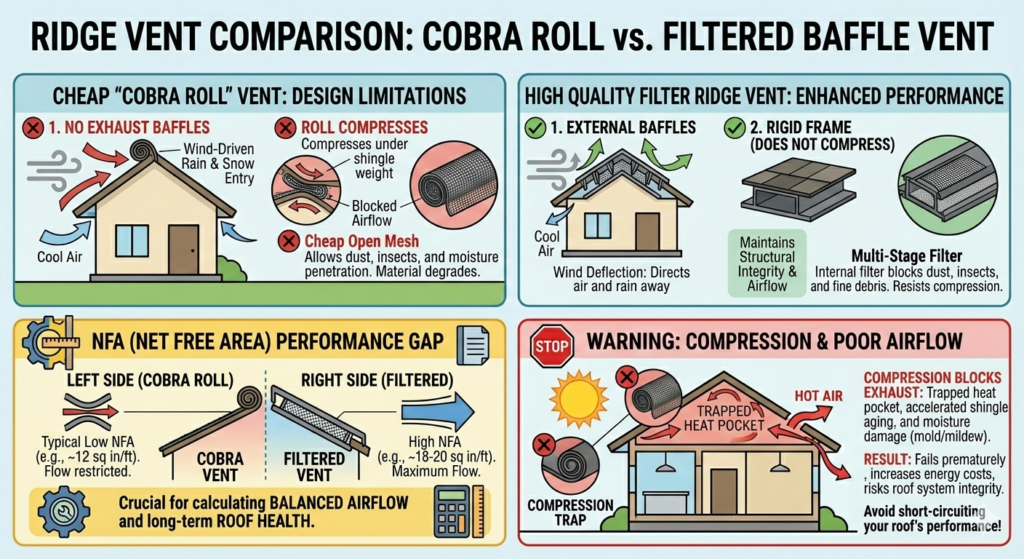
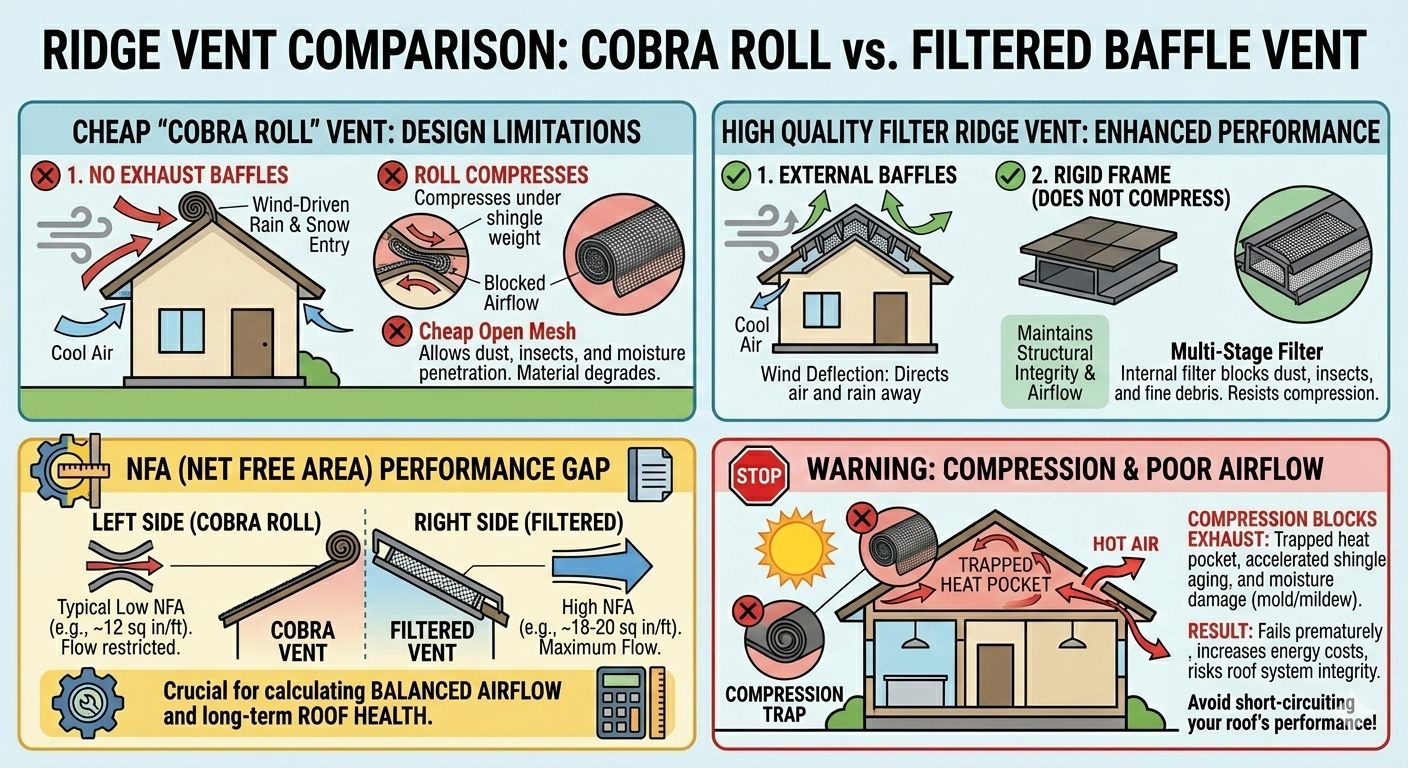
Mesh rolled ridge vents — often called Cobra rolls or just rolled vents — show up because they’re cheap, fast to install, and look fine from the ground. They’re a strip of plastic mesh that you literally unroll along the ridge, fold over, and cap with shingles. We’ve replaced miles of this stuff. Here’s what’s wrong with it:
1. No External Baffles
The whole point of a baffle is to deflect wind away from the vent opening so the wind doesn’t drive rain and snow directly into your attic. A rolled mesh vent has nothing on the outside doing that job. When the wind comes off the Atlantic in February — and it does — that mesh is essentially a sieve pointed straight at the weather. We’ve been in attics in Hampton and Rye and seen wet insulation directly under a rolled ridge vent. That’s not an installation issue. That’s the product.
2. It Compresses
The mesh is soft. Cap shingles get nailed through it. Over a few seasons of snow load and roofer foot traffic, the mesh compresses down to a fraction of its original thickness. Now the air gap that was supposed to be moving exhaust air out — that gap is gone. The vent is still there. It’s just doing nothing. Homeowners think they have ventilation. They don’t.
3. The Mesh Is Too Open
To compensate for the lack of baffles and structure, rolled vents use a relatively coarse mesh. Big enough for dust, big enough for fine debris, sometimes big enough for insects to push through if the mesh degrades. After 8-10 years of UV exposure, the polymer mesh starts breaking down — gets brittle, loses material, opens up. We pull these off and they crumble in our hands.
4. Low Net Free Area
This is the hidden killer. NFA is the actual amount of open ventilation area per linear foot of ridge vent. Rolled mesh vents typically deliver around 12 sq in/ft of NFA — and that’s when they’re new and uncompressed. Once they’ve been on a roof for a few seasons, real-world flow is often half that. A rigid externally baffled ridge vent gives you 18-20 sq in/ft. That’s not a little better. That’s 50-65% more airflow per foot of ridge.
What an Externally Baffled, Filtered Ridge Vent Does Differently
The kind we install — Owens Corning VentSure rigid roll, GAF Cobra Snow Country, Air Vent ShingleVent II, depending on the project — is a fundamentally different product. Same job, totally different engineering.
External Wind Baffles
Visible from the side as a small lip or wing along the edge of the vent. As wind hits the roof and travels up the slope, the baffle diverts the air upward over the vent opening. That creates a low-pressure zone right at the vent — which actually pulls exhaust air out of the attic. Bernoulli’s principle, basically. Same reason an airplane wing works. Your attic doesn’t just leak air out the top; it gets vacuumed out when the wind blows.
Side benefit: the same baffle that creates suction also blocks rain and snow from being driven into the vent. That’s why we don’t see wet insulation under a properly installed rigid ridge vent the way we do under rolled mesh.
Rigid Frame
The vent has actual structural ribs running through it. You can step on it, nail through it, dump cap shingles on it, and it holds its shape. The internal air channels stay open at full design dimension for the life of the roof. We’ve pulled rigid ridge vents off 25-year-old roofs and the airway is still wide open.
Multi-Stage Filter
Inside the vent, behind the baffle, is a filter media that catches fine debris — pollen, fine dust, insects, pine needle bits — before they get into the attic. It’s not a HVAC filter. It doesn’t restrict airflow meaningfully. But it keeps the attic clean and keeps the vent itself from clogging up over time.
High Net Free Area
18-20 sq in/ft. Stays at 18-20 sq in/ft. That number actually matters when an installer is calculating balanced ventilation — which we do on every roof — because the ridge vent’s exhaust capacity has to match the soffit intake capacity within a defined ratio. A vent that loses half its NFA after three winters wrecks that math, and the whole ventilation system underperforms.
Side-by-Side Comparison
| Spec | Cobra Roll / Rolled Mesh | Externally Baffled Rigid Vent |
|---|---|---|
| Net Free Area (NFA) | ~12 sq in/ft | 18-20 sq in/ft |
| External wind baffle | No | Yes |
| Compression resistance | Compresses under load | Rigid frame holds shape |
| Filter media | Open mesh, no real filter | Multi-stage filter |
| Wind-driven rain protection | Poor | Excellent (baffle deflection) |
| Insect / debris resistance | Degrades over time | Maintains over life of roof |
| Typical lifespan | 8-12 years before degrading | 25+ years (roof lifespan) |
| Cost difference per roof | $200-400 less | $200-400 more |
If you’ve gotten a quote that just says “ridge vent” without specifying the product, ask. Specifically ask whether it’s a rigid externally baffled ridge vent or a rolled mesh vent. The wrong answer is costing you 50% of your attic exhaust capacity for the rest of the roof’s life.
The Real Cost: What Bad Ridge Venting Does to a Roof
This isn’t a theoretical problem. We see the consequences when we tear off old roofs. The pattern is consistent.
Premature Shingle Failure
Trapped attic heat cooks shingles from underneath. The shingle manufacturer designed the asphalt for a normal attic temperature range. When the attic runs 30°F hotter than it should because the exhaust isn’t moving, the shingle’s asphalt mat ages faster — granules let go sooner, shingles get brittle sooner, the roof needs replacement 5-7 years earlier than it should. Owens Corning, GAF, and CertainTeed all reduce or void shingle warranties on roofs with inadequate ventilation. They’re not bluffing.
Sheathing Rot
In winter, warm moist air from the house leaks into the attic. With proper exhaust ventilation, that moisture gets carried out the ridge vent and is gone. With a compressed or undersized ridge vent, the moisture hits the cold underside of the roof deck and condenses. We’ve cut chunks of rotted OSB out of attics in Wolfeboro and Belmont where the sheathing was so saturated it was crumbling under our hands. Replacing decking is several thousand dollars added to a roof job. Avoidable with proper venting.
Mold and Mildew
Same mechanism — trapped moisture. Once the attic gets above about 60% relative humidity for sustained periods, mold starts. We see it on rafters, on the underside of decking, in insulation. By the time it’s visible from inside the attic, it’s been growing for months.
Ice Dams (in Winter)
Trapped attic heat melts the bottom layer of snow on the roof. That meltwater runs down to the eave, refreezes when it hits the cold overhang, and you get an ice dam. Better attic exhaust = colder roof deck = less melting = fewer ice dams. People think ice dams are an insulation problem. They’re an insulation and ventilation problem.
Regional Notes — Why This Matters in NH, MA, and ME Specifically
How Climate Affects Ridge Vent Choice
Different parts of our service area put different stresses on a ridge vent. The right product matters everywhere — but the failure modes look different by region:
Seacoast NH (Stratham, Portsmouth, Hampton, Rye)
Constant Atlantic wind plus salt air. Wind-driven rain hammers ridge vents harder here than almost anywhere we work. The external baffle isn’t a luxury — it’s the only thing keeping water out of your attic during nor’easters.
Lakes Region NH (Laconia, Meredith, Wolfeboro)
Heavy snow load means rolled mesh vents get crushed flat under snowpack and never recover. Rigid frame ridge vents hold their air channels open even with three feet on the roof.
Inland NH and Northern MA
Tree canopy means more pollen, leaves, and pine debris. The internal filter on a quality ridge vent keeps that material out of your attic where it’d otherwise pile up under the vent over years.
Southern ME (Kittery, York, Eliot)
Same coastal exposure as Seacoast NH plus older housing stock. We see a lot of older homes here with original rolled mesh vents that have been failing silently for 15 years. Replacement is overdue on a lot of these roofs.
How to Tell What’s On Your Roof Right Now
From the ground with binoculars, look at the ridge of your roof. Two clues:
- Profile — A rigid externally baffled ridge vent has a slight but visible “shoulder” or step where the baffle sits. A rolled mesh vent looks almost flat — just a small bump under the cap shingles.
- Age of the roof — If your roof is more than 10-12 years old and the original installer used rolled mesh, the vent is likely already underperforming even if you can’t see anything wrong from the ground.
Inside the attic, look up at the ridge during the day. You should be able to feel air movement and (with proper soffit intake) see daylight through the vent slot at the peak. If the air feels stagnant, hot, or you can see compressed mesh up there, your ridge vent is the problem.
What We Install and Why
On every Compass-installed roof, we use a rigid externally baffled ridge vent — typically Owens Corning VentSure (we’re an Owens Corning Preferred Contractor, so we use their system end-to-end on most jobs) or an equivalent rigid-rolled product when the ridge profile calls for it. We never install rolled mesh ridge vents. Not on new roofs, not on replacements, not as a “budget option.”
The cost difference for the homeowner on a typical NH roof is $200-400 over the entire job — call it 1-2% of the total roofing cost. For that, you get a vent system that delivers full design airflow for the life of the roof, doesn’t leak in driving rain, doesn’t crush under snow load, and keeps your shingle warranty intact. There’s no version of the math where rolled mesh wins.
Frequently Asked Questions
Can I just replace the ridge vent without redoing the whole roof?
Yes — if the rest of the roof is in good shape. We can pull off the existing ridge cap and rolled vent, install a rigid externally baffled vent in its place, and re-cap with new shingles matched to your existing roof. It’s a half-day job in most cases. We’ll inspect the rest of the roof while we’re up there at no charge.
Is a “Cobra” vent always bad? I’ve heard the brand name.
Confusing terminology — “Cobra” is a GAF product line, and they make both the rolled mesh version (Cobra Original / Cobra Exhaust Vent) and a high-quality rigid externally baffled version (Cobra Snow Country). The rolled one is what we’re criticizing here. The rigid Snow Country product is fine — it’s a real ridge vent.
How much ridge vent do I need on my roof?
Depends on attic square footage and the ratio of soffit intake to ridge exhaust. The general rule is 1 sq ft of NFA per 300 sq ft of attic, split roughly 50/50 between intake (soffit) and exhaust (ridge). On a typical 2,000 sq ft NH home, that’s around 6.7 sq ft of total NFA — and you have to actually achieve that with the vent products you’re using. We calculate this on every job.
What if my roof doesn’t have soffit vents?
Then a ridge vent alone won’t solve your ventilation problem — you need both intake and exhaust for the airflow loop to work. Ridge vent without soffit intake is essentially useless and can sometimes pull conditioned air up out of the house, which is worse than no vent at all. We can install soffit venting as part of a roof replacement or as a standalone retrofit. Common situation on older NH homes with no original soffit vents.
Will replacing my ridge vent void my existing roof warranty?
Generally no, as long as it’s installed correctly by a qualified contractor. In some cases it actually preserves warranty coverage that was at risk because of poor existing ventilation. We can tell you specifically based on your shingle manufacturer.
How much does a quality ridge vent add to a roof replacement cost?
Roughly $200-400 over rolled mesh on a typical NH home. On a $14,000-$22,000 roof job, it’s a tiny percentage. Anyone proposing to save you $200 by using rolled mesh is making a bad trade on your behalf.
How long does a rigid externally baffled ridge vent last?
The same lifespan as the roof itself — 25-30 years on a good architectural shingle roof, 40-50+ on a metal roof. We’ve never had to replace a Owens Corning VentSure or equivalent before the rest of the roof was due for replacement.
What to Do Next
If you’re getting roofing quotes — or just want to know what’s actually on your ridge — we’ll come take a look. Free, no pressure, no drone-from-the-driveway. We’re an Owens Corning Preferred Contractor and we install rigid externally baffled ridge vents on every roof we do, because the other kind doesn’t last.