
We tore off a 14-year-old architectural shingle roof in Stratham last fall. The warranty said 30 years. The homeowner was furious â and honestly, so were we, because we could tell within about ninety seconds why those shingles had baked themselves to death.
There was no ridge vent. The soffits had been painted over three times. The attic was pulling 140°F on a warm day. That roof never had a chance. And this isn’t a rare story in Southern NH â we see it constantly.
Attic ventilation is the single most overlooked factor in roof lifespan. It’s not glamorous. It’s not what the salesman talks about. But get it wrong, and a premium shingle roof will underperform a builder-grade roof installed correctly. Get it right, and you buy yourself an extra ten years of service life. Here’s what homeowners across New Hampshire need to understand.
What Attic Ventilation Actually Does
The basic job is simple: pull fresh air in at the soffits, push hot/humid air out at the ridge. Air moves through the attic space continuously â 24/7, winter and summer. That constant airflow does two things that matter for your roof.
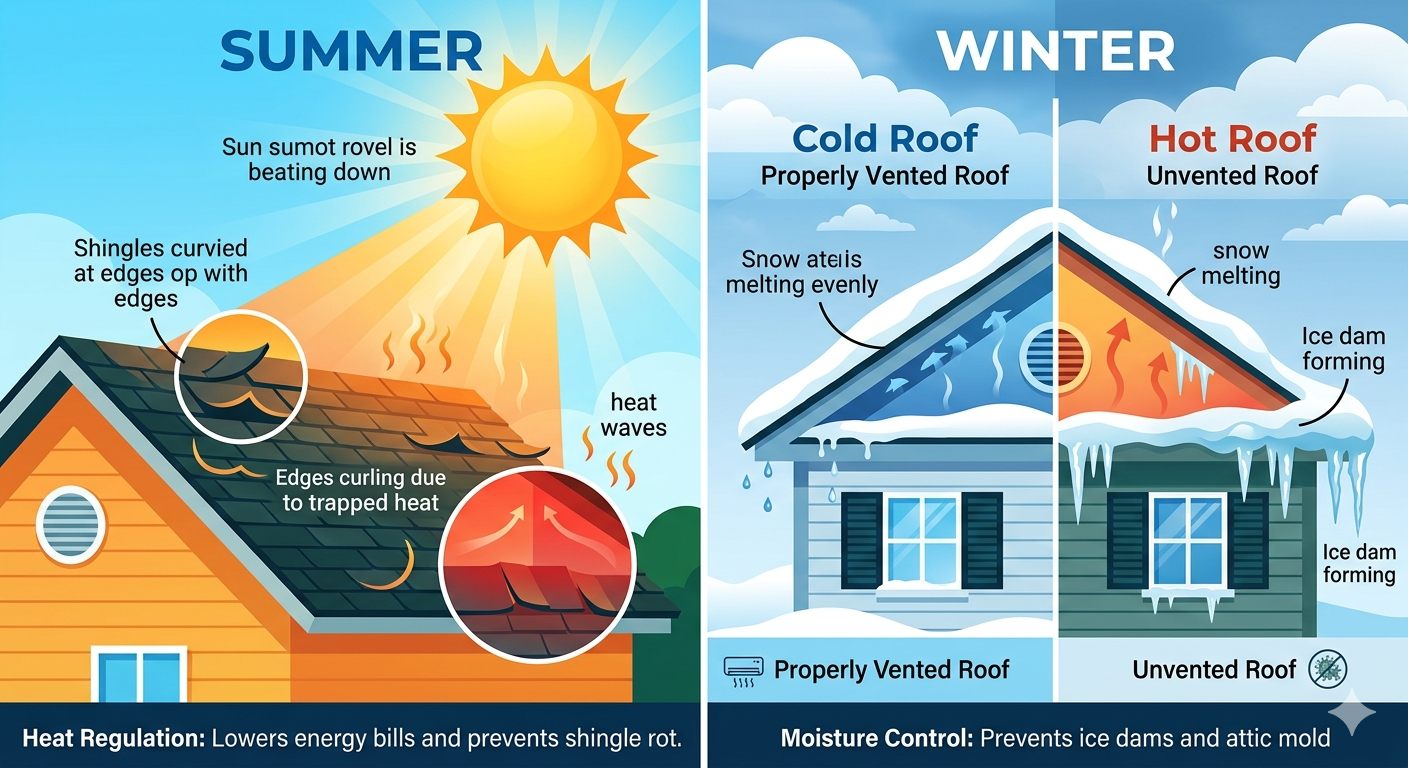
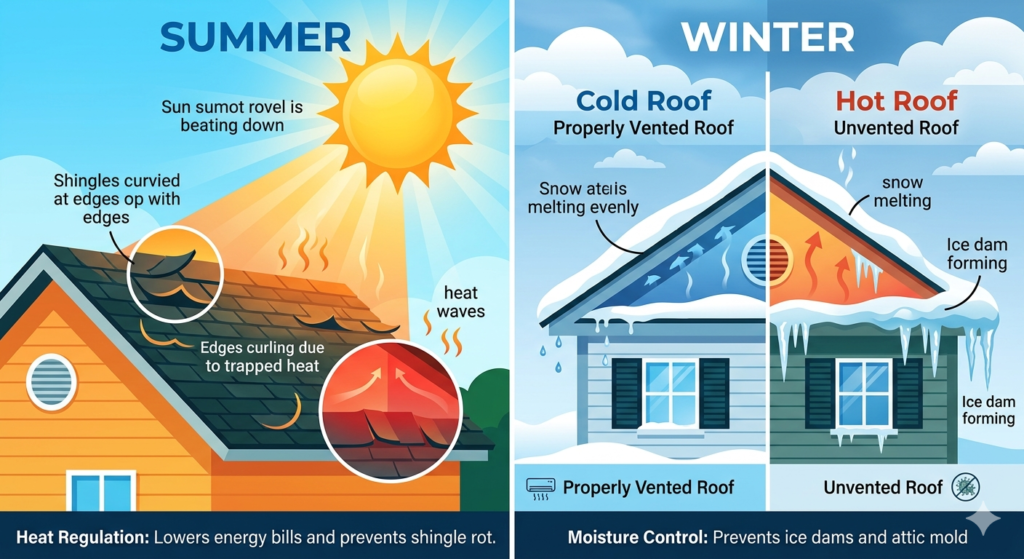
In summer, it dumps heat. An unvented or poorly vented attic in July can hit 150°F under a dark asphalt roof. That heat cooks the asphalt from underneath, accelerating granule loss, drying out the mat, and causing the shingles to curl and crack years ahead of schedule. We’ve pulled up shingles on 12-year-old roofs that were brittle like potato chips. Every one of them had a ventilation problem.
In winter, ventilation is even more important â and this is where most New England homes really get hurt. When warm, moist air from your living space leaks into the attic (and it always does, no matter what anyone tells you), it condenses on the cold underside of the roof deck. Over years, that moisture rots the sheathing, rusts nails, and grows mold. Worse, that trapped warmth melts snow on the roof, which refreezes at the eaves and forms ice dams. Every ice dam we respond to in January can be traced back to some combination of poor insulation and poor ventilation.
The Word You Need to Know: Balanced
Here’s where almost everyone gets it wrong, including a lot of roofers who should know better. Ventilation isn’t about having vents â it’s about having balanced intake and exhaust.
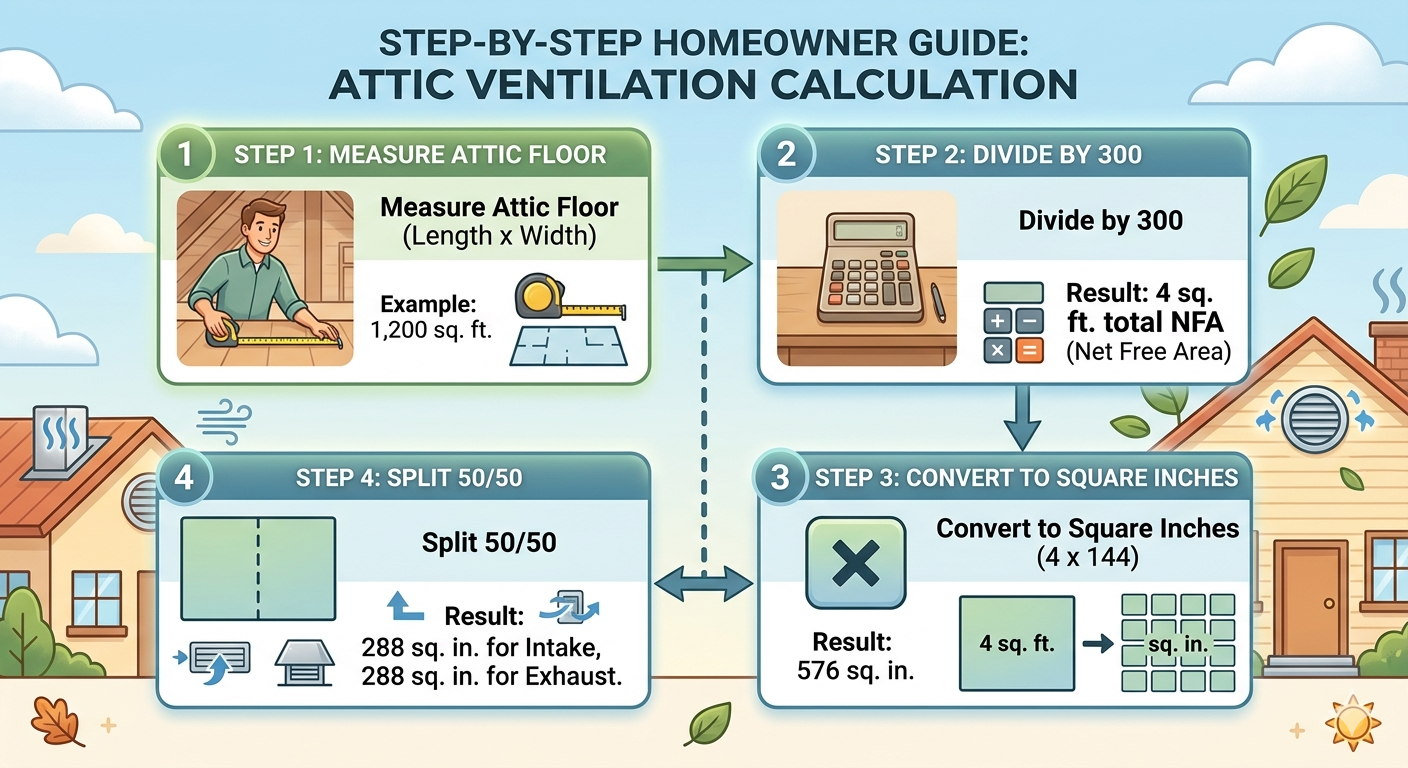
The building code and every shingle manufacturer call for a minimum of 1 square foot of net free vent area for every 300 square feet of attic floor, split roughly 50/50 between intake (soffits) and exhaust (ridge). If your soffits are blocked and you only have a ridge vent, that ridge vent becomes an intake. It starts pulling air down the roof, which means it’s pulling rain and snow in with it. We’ve seen insulation soaked from this exact problem.
Conversely, if you have plenty of soffit intake but no exhaust, the air has nowhere to go. It just sits there, stagnant.
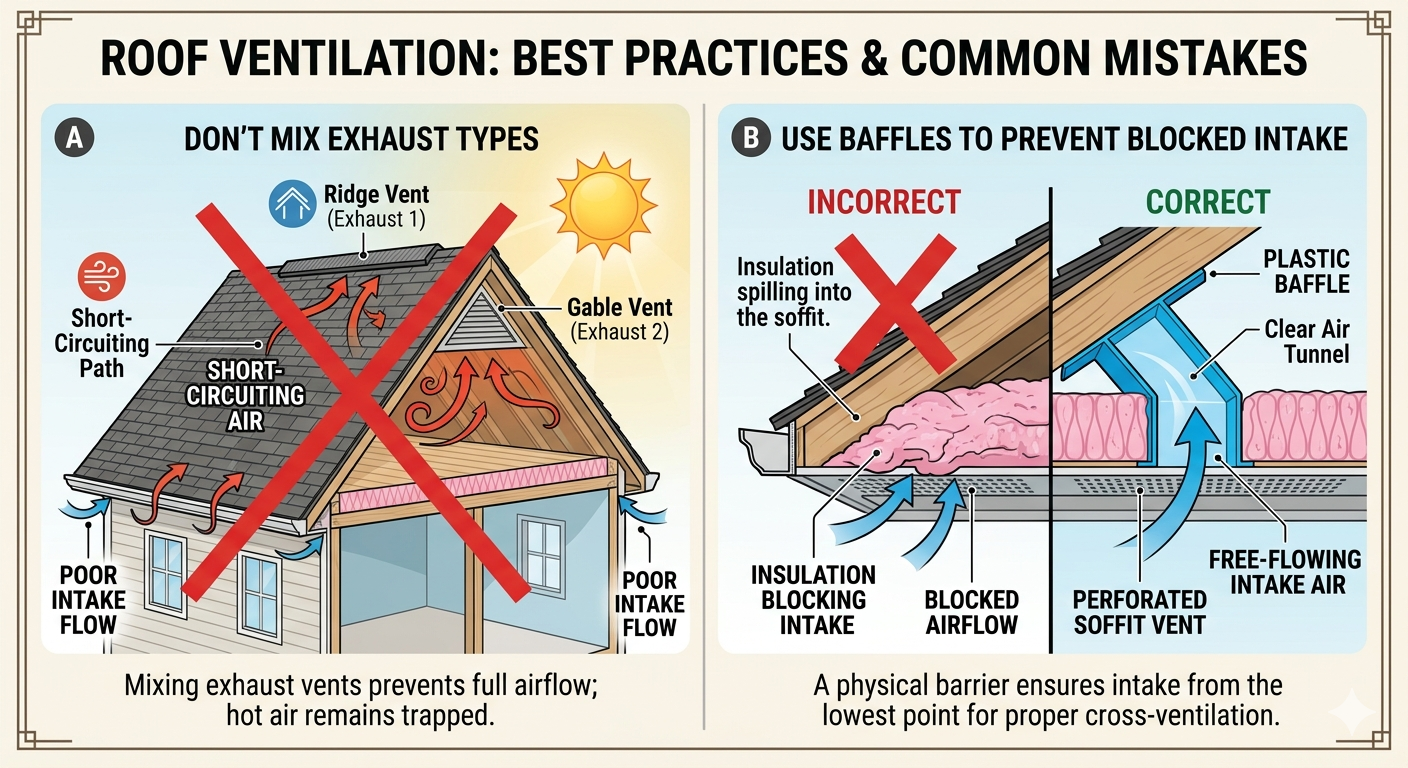
Worst of all â and this is something the big-box stores love to sell people â is mixing vent types. Ridge vent plus gable vents plus a powered attic fan all on the same roof. What happens? The powered fan short-circuits the airflow, pulling conditioned air right out of your house through any gap it can find. The gable vents become intake for the ridge vent instead of the soffits doing their job. Nothing works the way it should. Pick one exhaust strategy and commit to it.
Quick Tip â The soffit test: On a clear day, stand in your attic and look at the soffits from inside. You should see daylight through the baffles. If you see fiberglass insulation jammed against the roof deck or painted-shut soffit vents, your intake is dead â and your “ventilation system” is not working, regardless of what’s at the ridge.
Signs Your Attic Ventilation Is Failing
Most homeowners have no idea whether their attic breathes properly. These are the symptoms we look for during an inspection:
- Shingles curling, cupping, or cracking well before warranty age (especially on the south-facing side)
- Dark streaks and heavy granule loss in gutters beyond what the roof age would suggest
- Rusted roofing nails visible from inside the attic â condensation is the cause
- Frost on the underside of the roof deck in January or February
- Mold or dark staining on roof sheathing or rafters
- Ice dams every winter â especially if you’ve tried heat cable and it didn’t help
- Attic temperatures above 130°F on a hot summer day
- Upstairs rooms that never cool down in summer no matter what the thermostat says
- Spongy or soft roof decking when we walk the roof â this is advanced-stage moisture damage
If you see two or three of these, the ventilation is almost certainly inadequate. If you see five or more, the damage is likely already done and a ventilation fix alone won’t save the roof.
Types of Vents â And What Actually Works in New England
Ridge Vent
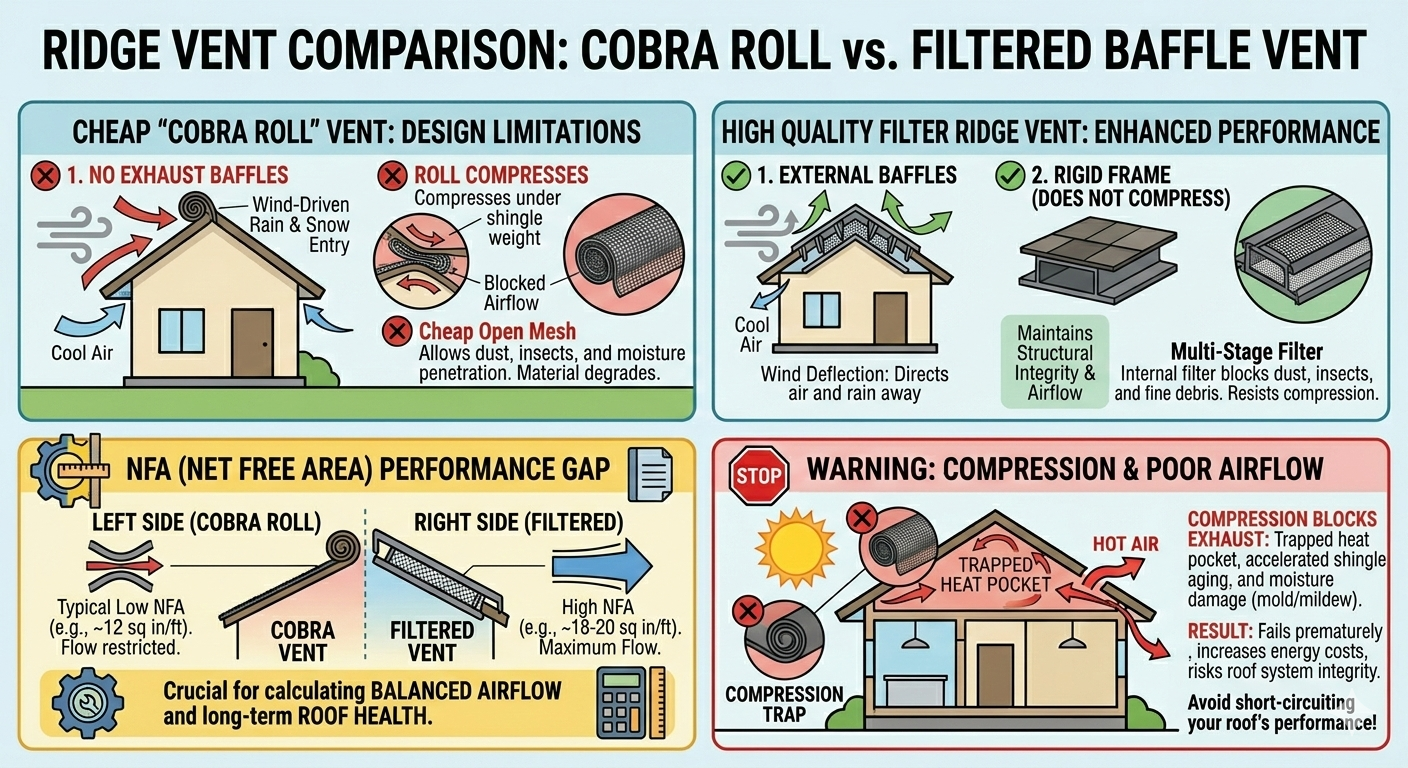
A continuous vent cut into the peak of the roof, covered with a baffled ridge cap. This is our default exhaust method on virtually every job we do. It works with the natural stack effect â hot air rises and exits. Pairs perfectly with continuous soffit vents. The modern externally-baffled ridge vents (Cobra II, ShingleVent II, and similar) shed snow and driven rain far better than the old-style unbaffled products.
Soffit Vents
Continuous vented soffit panels are the gold standard for intake. If your home has solid soffits, you can retrofit individual round vents, but continuous is better. Whatever you have, the insulation inside the attic must be held back from the roof deck with rafter baffles (sometimes called ProperVents or AccuVents) so air can actually flow.
Gable Vents
Louvered vents at each end of the attic. Fine on older homes where the roof geometry doesn’t support a ridge vent. But do not mix gable vents with ridge vents â you’ll create a short circuit that defeats both.
Powered Attic Fans
We pull these out far more often than we install them. They sound like a good idea â “just suck the hot air out!” â but research consistently shows they pull conditioned air out of your house faster than they pull hot air out of the attic. If your attic has balanced passive ventilation, you don’t need one. If it doesn’t, adding a fan makes things worse, not better.
Solar Powered Roof Vents
Better than electric, because they only run when the sun is out and can’t drain your AC all night. Still a band-aid. If we’re doing a full roof replacement, we’d rather fix the passive system than add a powered solution.
Attic Insulation and Ventilation Go Together
You cannot talk about ventilation without talking about insulation and air sealing. They’re a system. A poorly insulated attic with great ventilation is still going to have ice dams, because the warm air is coming up from the house and the vents can’t keep up. A well-insulated attic with terrible ventilation will trap moisture.
The fix order, when we do this work: air-seal first (top plates, can lights, attic hatch), then insulate to R-49 or better, then ensure ventilation is balanced. All three steps or you’re wasting money.
On a lot of our older homes in Portsmouth, Exeter, and Dover â anything built before 1990 â we find R-13 or R-19 insulation, paintable soffits that were painted shut thirty years ago, and no air sealing to speak of. Fixing this is often more valuable than the new roof itself.
What It Costs to Fix Ventilation
If you’re replacing the roof anyway, adding a proper ridge vent is a relatively small upgrade â typically $400 to $900 on a mid-size home. Cutting in soffit vents where none exist runs $300 to $800 depending on access and whether we’re replacing the soffit material. Retrofitting rafter baffles from inside the attic is labor-intensive but usually under $1,200 on a standard 1,800-sq-ft home.
The bigger cost comes if you’re trying to fix ventilation without replacing the roof. Cutting in a ridge vent on an existing roof requires pulling ridge shingles, cutting the sheathing, installing the vent, and re-shingling the cap. Not difficult work, but not cheap. Budget $800 to $1,500 on most homes.
Ventilation by Region â Why NH Is Different
New Hampshire isn’t one climate. What works on the Seacoast doesn’t always work in the Lakes Region, and what works inland doesn’t always work on the coast.
Seacoast NH (Portsmouth, Exeter, Stratham, Hampton, Dover, Rye): Salt air is the hidden enemy. We specify stainless or galvanized components for coastal homes within about three miles of the water. Moisture levels run high year-round, which makes ventilation even more critical â attics here get damp fast when airflow is inadequate.
Lakes Region NH (Laconia, Meredith, Wolfeboro, Gilford, Belmont): Deep snow load and brutal freeze-thaw cycles. Ice dams are practically a regional sport here. Balanced ventilation combined with R-49+ insulation is the only combination that genuinely prevents them. We’ve stopped chronic ice dam problems on Winnipesaukee-area homes with a full ventilation retrofit alone â no new roof required.
Inland Southern NH (Nashua, Manchester, Concord corridor): Heavy snow loads combined with wide temperature swings. Ventilation failures here usually show up as premature shingle aging on south-facing slopes where summer heat bakes the underside.
Northern MA (Newburyport, Amesbury, Haverhill, Merrimac, Newbury): Similar coastal dynamics to the NH Seacoast. We see a lot of older colonials here with totally unvented attics â they were never designed for modern insulation levels and trap moisture severely.
Southern ME (Kittery, York, South Berwick, Eliot, Berwick): Heavy snow plus coastal moisture. Same story as the Lakes Region in terms of ice dam risk. Balanced venting is non-negotiable for this climate.
Common Mistakes Homeowners Make
- Adding a power fan to solve a ventilation problem. As we covered â this almost always makes things worse.
- Stuffing insulation all the way to the roof deck. Kills soffit intake completely. Rafter baffles are not optional.
- Painting over vented soffits. We see this on almost every older home. Paint fills the perforations and the soffit becomes solid.
- Mixing vent types. Gable vents plus ridge vents. Power fan plus ridge vent. Short-circuits every time.
- Ignoring the problem because the roof “looks fine from the street.” By the time you see damage from the ground, the underlying deck is usually already compromised.
When to Have Your Attic Evaluated
Honestly? Anytime you’re planning a roof replacement. The new roof is the time to get ventilation right â not five years later when you’re wondering why your warranty claim got denied.
Beyond that, anyone with recurring ice dams, persistent second-floor cooling issues, or shingles that look prematurely aged should have a contractor physically inspect the attic. We climb into them. We take temperature readings. We look at the insulation depth and the soffit condition. It’s not something you can diagnose from a drone or a ladder.
Attic Ventilation FAQs
Does poor attic ventilation void my shingle warranty?
Yes â every major shingle manufacturer (Owens Corning, GAF, CertainTeed, Malarkey) explicitly requires proper ventilation as a condition of warranty coverage. If your shingles fail early and the manufacturer determines ventilation was inadequate, they can deny the claim entirely. This is one of the most common reasons warranty claims are rejected.
How much ventilation does my attic need?
The standard code requirement is 1 square foot of net free ventilation area per 300 square feet of attic floor space, split evenly between intake and exhaust. On a 1,800 sq ft attic, that’s 6 sq ft total â 3 sq ft of intake at the soffits, 3 sq ft of exhaust at the ridge. Some codes allow 1:150 if ventilation is split 50/50 between eaves and near the ridge.
Will better ventilation prevent ice dams?
It helps significantly, but ventilation alone rarely fixes chronic ice dams. The combination that works is air sealing the attic floor, insulating to R-49 or higher, and ensuring balanced ventilation. All three together keep the roof deck cold, which is what actually prevents ice dams.
Do I need an attic fan?
Probably not. If your passive ventilation is balanced and sized correctly, a power fan adds no benefit and usually hurts by pulling air-conditioned air out of your house. The only scenarios where we occasionally install powered ventilation are complex roof geometries where a continuous ridge isn’t possible.
Can I add a ridge vent without replacing my roof?
Yes. It’s a common retrofit. We remove the ridge cap shingles, cut a slot through the sheathing along the peak, install the ridge vent, and re-shingle the cap. Expect $800 to $1,500 on a standard home. If your soffit intake is also compromised, both should be addressed at the same time â a ridge vent without matching intake creates more problems than it solves.
How do I know if my soffit vents are working?
Two tests. First, from outside, look up at the soffits â you should see perforated vent panels, not solid painted wood. Second, from inside the attic on a sunny day, look down toward the eaves. You should see daylight around the edges where air enters. If it’s dark, the insulation is blocking the intake and nothing’s getting through.
My home has gable vents. Is that enough?
It can be, on simpler roof shapes, but it’s not ideal. Gable vents don’t move air through the full attic â they mostly circulate near the gable ends. For modern ventilation performance, continuous soffit intake plus continuous ridge exhaust is the superior system. If you have gable vents and are adding a ridge vent, we’d typically recommend closing off the gables.
How long does it take to retrofit attic ventilation?
Most ventilation retrofits take one to two days on a standard home. If we’re cutting in a ridge vent, replacing soffit panels, and installing rafter baffles throughout, figure two days. If we’re doing it as part of a full roof replacement, it adds almost no additional time â a few hours at most.
What to Do Next
If your roof is underperforming its warranty, your upstairs is hot in summer, or you’ve fought ice dams every winter â the attic is probably the problem. We’re an Owens Corning Preferred Contractor and every inspection we do includes a hands-on attic evaluation. No drones, no drive-by estimates. We climb up there and tell you what’s actually going on.
Schedule a free inspection or call us at 603-219-1523.