
We get this question on almost every estimate we run. Homeowner walks us around the back of the house, points up, and says: “I’ve been thinking about going metal. What do you think?” Sometimes they’ve seen a neighbor’s standing seam roof catch the morning sun. Sometimes they’ve priced it online and the number scared them. Sometimes they just want the truth from somebody who installs both.
So here’s the truth. Asphalt vs. metal roofing in NH isn’t a simple winner-and-loser conversation — it’s a conversation about your house, your plans, and what you actually want the roof to do for the next 30 to 50 years. In this post we’ll break down the real cost difference, how each material holds up in our climate, the noise question everybody asks, and when metal genuinely makes sense versus when architectural asphalt is the smarter call. No sales pitch. Just the stuff we tell people while we’re standing on their driveway.
The Short Version
If you want the TL;DR before we get into details: most homes in Southern NH and the Lakes Region are better served by a quality architectural asphalt shingle. It’s cheaper upfront, it performs beautifully in our climate when installed correctly, and the economics of metal — while compelling on paper — only pay off if you’re planning to stay in the house 25+ years. Metal shines on certain homes. Lake houses, barn-style builds, low-slope sections that bleed onto lower roofs, cottages up north. But it’s not automatically “better.” It’s different.
Now let’s get into the actual details.
Cost: What Each One Actually Runs in NH
Let’s start with the number that matters most to homeowners. These are real 2026 installed pricing ranges we see in our service area — Southern NH, the Seacoast, Lakes Region, York County Maine, and the Merrimack Valley. Prices are influenced by access, pitch, tear-off layers, and decking condition.
| Material | Installed Cost (per sq. ft.) | Typical 2,400 sq. ft. Roof |
|---|---|---|
| 3-Tab Asphalt | $4.50 – $6.50 | $10,800 – $15,600 |
| Architectural Asphalt | $5.50 – $8.50 | $13,200 – $20,400 |
| Premium / Designer Asphalt | $9.50 – $14.00 | $22,800 – $33,600 |
| Exposed-Fastener Metal | $9.00 – $13.50 | $21,600 – $32,400 |
| Standing Seam Metal | $14.00 – $22.00 | $33,600 – $52,800 |
| Stone-Coated Steel | $12.00 – $17.00 | $28,800 – $40,800 |
A good way to think about it: a quality architectural asphalt roof — which is what we install 90% of the time — runs roughly half the cost of standing seam metal on the same house. We’ve seen homeowners get metal quotes that come in at $55,000 on homes where our architectural quote was $22,000. That’s a $33,000 gap you have to earn back over the life of the roof.
Quick tip: Don’t compare a standing seam quote to a 3-tab quote. That’s apples to rocket ships. The fair comparison is architectural asphalt vs. standing seam metal — those are both considered premium installations and represent where most homeowners actually make the decision.
Lifespan: How Long Will Each One Last?
This is where metal gets its reputation. And fairly so.
Asphalt shingles
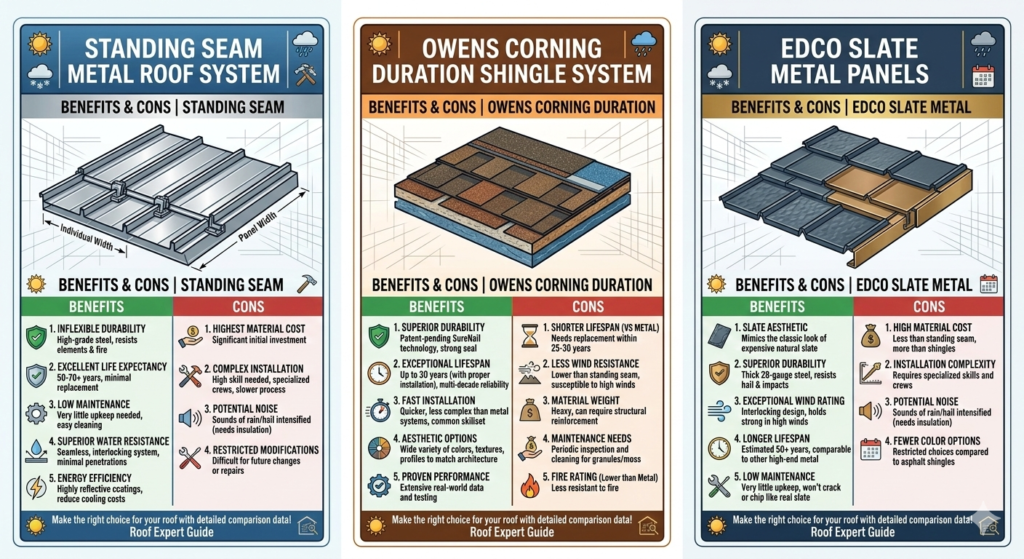
Architectural asphalt carries a limited lifetime warranty, but the realistic service life in New Hampshire is 25 to 35 years. We’ve pulled off 22-year-old architecturals in Exeter that still had life in them. We’ve also pulled off 18-year-old ones in Hampton where the shingles cooked on south-facing slopes and turned granules into loose gravel in the gutters. Ventilation matters more than warranty fine print. A poorly vented attic can cut an asphalt roof’s life by a third, easy.
Metal roofing
Standing seam metal? 50+ years is realistic, often 60 or 70. The steel itself won’t wear out in any meaningful sense. What fails first is the paint finish — and even then you’re talking 40+ years before a decent Kynar 500 PVDF coating starts to chalk or fade. Exposed-fastener metal (think ag panels) has a shorter functional life — roughly 30 to 40 years — because the rubber gaskets on the screws dry out and start to leak somewhere around the 20-year mark.
So in pure lifespan terms: metal wins. But here’s the kicker — if you’re 55 years old and you install architectural asphalt today, it’ll almost certainly outlive you in that house. Paying double for a roof you won’t be around to depreciate isn’t always the smart play.
How Each Performs in NH Weather
This is the part where local context really changes the answer. A metal roof in Phoenix is a different product than a metal roof in Meredith. Let’s talk about what our climate actually does to roofing.
Snow and ice
Metal is slicker — snow slides off. In the Lakes Region and inland NH where we get real snow load, this matters. A standing seam roof can shed three feet of wet snow in an afternoon, which protects your structure and prevents ice dams at the eaves. But here’s the flip side: all that snow comes down at once. If your entry door, AC condenser, propane tank, deck, or shed is sitting below a metal slope, you’re going to need snow guards. We install them routinely on metal jobs, and they add cost.
Asphalt holds snow more evenly, which means less sudden sliding — but it also means ice dams if your attic isn’t properly vented and insulated. Both materials can work fine up north. The difference is what you do at the eave and along the valleys to handle the load.
Wind
Standing seam metal is one of the most wind-resistant roofs on the market — we’ve installed panels rated to 140+ mph. Along the Seacoast (Rye, Hampton, Portsmouth), where we get nor’easter gusts blowing in off the ocean, that’s a real advantage. Architectural asphalt typically carries a 110-130 mph wind warranty when installed with six nails per shingle and high-wind starter strips. Both hold up in an average storm. Metal has a meaningful edge in the worst ones.
Salt air
If you’re within a half-mile of the ocean — we’re talking Hampton Beach, North Hampton, Rye, New Castle, Kittery Point — salt air is a material killer. Some painted steel panels will spot-rust at cut edges within 10 years of exposure to that environment. Aluminum standing seam is the right call for oceanfront houses, and it costs a bit more than steel. Asphalt shingles handle salt air fine, which is one reason they’re still the dominant material in coastal NH.
Freeze-thaw cycles
The Lakes Region (Laconia, Gilford, Belmont, Meredith, Wolfeboro) goes through brutal freeze-thaw cycles. Water freezes in a shingle crack, expands, and widens that crack a micron at a time. Over 25 years, that’s what kills asphalt. Metal doesn’t have that failure mode — it expands and contracts as a sheet and couldn’t care less about ice in crevices. Score one for metal.
The Noise Myth
“Doesn’t a metal roof sound like being inside a popcorn machine during a rainstorm?”
No. Not on a modern installation. That myth comes from pole barns and sheds where metal is laid directly over open framing with no deck, no underlayment, and no attic space between you and the panel. On a house, metal goes over a solid deck (usually 5/8″ plywood), a synthetic underlayment, sometimes an additional sound-dampening membrane, and then you’ve got attic insulation between the deck and your ceiling. A standing seam roof in a rainstorm is actually quieter in the bedroom than some asphalt roofs, because the mass and the layers absorb sound differently than you’d expect.
We’ve installed metal on enough homes to say this with confidence: nobody moves back to asphalt because of noise. That’s not a thing.
Looks and Resale
This is where taste takes over, and honestly, you’re a better judge than we are on the aesthetic question. What we can tell you is what sells in our market.
In the Seacoast and inland NH, architectural asphalt in a mid-tone color (Weathered Wood, Driftwood, Onyx Black) is what 85% of buyers expect. It reads as “a nice normal roof.” A premium designer shingle like Owens Corning’s Berkshire or CertainTeed Grand Manor can add curb appeal to a higher-end home.
Standing seam metal reads as either “upscale” or “unusual” depending on the architecture. On a modern farmhouse, barn-style home, or lake cottage, it looks fantastic and often boosts appraisal. On a traditional colonial in a neighborhood full of asphalt roofs, it can actually hurt resale because buyers see it as non-standard. If you’re planning to sell in under 10 years, don’t put metal on a house where metal looks out of place.
Quick tip: Drive your neighborhood. If you see three or more metal roofs within a mile, metal is “normal” in your market and won’t hurt resale. If yours would be the only one on the block, think hard before you commit — you’ll have a smaller buyer pool when you list.
When Metal Genuinely Makes Sense
We’re not anti-metal. We install it, and when it’s the right call, we’ll tell you. Here’s when we push homeowners toward metal:
- Low-slope sections. Anything under a 3:12 pitch really shouldn’t have asphalt on it. Standing seam handles low slopes down to around 1:12 with proper detailing. We see this a lot on porch roofs and additions.
- Lake homes and cottages. Aesthetic fit is strong, snow-shed is a bonus, and owners often plan to hold the property across generations — the 50+ year lifespan actually gets used.
- Oceanfront homes. Aluminum standing seam holds up to salt air better than almost anything. If you’re on the water in Rye or York Harbor, it’s worth the premium.
- Homes with persistent ice dam issues. If you’ve tried everything (attic sealing, insulation, ventilation) and still fight ice dams every winter, a metal roof is the last-ditch fix that actually works.
- Barn-style or modern farmhouse architecture. Some houses just look wrong with asphalt. You’ll know yours when you see it.
- Forever homes. If you’re 40 years old and staying put, the 50-year lifespan on metal is a real value over the second asphalt roof you’d otherwise pay for.
When Asphalt Is the Smarter Call
Which, to be clear, is most of the time. Asphalt is right when:
- Budget is tight or you want the lowest responsible cost per year of service
- Your architecture is traditional (colonial, cape, garrison, ranch) — asphalt fits the vocabulary
- You plan to sell within 10-15 years
- Your neighborhood is entirely asphalt roofs — buyer expectations matter
- You want fast installation (most asphalt roofs go on in 1-2 days vs. 3-5 for standing seam)
- You want wider color and style selection — asphalt has dozens of options; metal has maybe 10
Our default recommendation for a homeowner on a standard NH house is an Owens Corning Duration architectural shingle with SureNail technology. It carries a 130 mph wind rating, has a realistic 30-year service life, and runs about half what standing seam would cost on the same roof. That’s the math most families should do.
Regional Considerations Across Our Service Area
Where you live changes the calculus. Here’s how we think about it by region:
Seacoast NH (Exeter, Stratham, Portsmouth, Hampton, Dover, Newmarket): Salt air is a factor within a half-mile of the ocean. Wind exposure during nor’easters is real. Architectural asphalt is our default; aluminum standing seam is the upgrade path for oceanfront homes.
Lakes Region NH (Laconia, Meredith, Gilford, Wolfeboro, Belmont): Heaviest snow loads in our service area. Freeze-thaw cycles are brutal. Metal’s snow-shed and long lifespan genuinely earn their premium on lake cottages. Architectural asphalt still works on inland homes with good ventilation.
Northern MA (Newburyport, Amesbury, Haverhill, Merrimac): Similar to Seacoast NH — coastal influence, nor’easter exposure, traditional architecture. Architectural asphalt dominates; metal is a strong option on barn-style or waterfront homes along the Merrimack.
Southern ME (Kittery, York, South Berwick, Eliot, Berwick): York County housing stock leans toward coastal cottages and older colonials. Salt air matters on oceanfront properties; inland homes are straightforward asphalt candidates.
One Last Thing: Installation Quality Matters More Than Material
We’ll end on this because it’s the single most important point in the whole conversation. A poorly installed metal roof will fail before a well-installed asphalt roof. We’ve seen metal jobs with exposed fasteners that were overdriven, panels that weren’t properly flashed at chimneys, and penetrations that leaked inside of five years. A fifty-thousand-dollar roof installed badly is worse than a twenty-thousand-dollar roof installed right.
Whichever material you choose, the contractor matters more than the product. Look at their actual install photos. Ask to see a completed metal job, walk around it, inspect the eaves and the ridge. Check that they’re running physical in-person inspections — not drone flyovers. Get references from homes they roofed 10+ years ago. That’s the only way to know what you’re buying.
Frequently Asked Questions
Is a metal roof really worth double the cost of asphalt?
Sometimes. If you’re staying in the house 25+ years and your architecture suits metal, the per-year cost is actually similar because you’ll replace asphalt once in that window. If you’re selling within 10 years, the metal premium won’t come back at resale in most NH markets. Run the math against your actual timeline.
Will a metal roof lower my homeowner’s insurance in NH?
Some carriers offer a discount for impact-resistant metal roofs — usually 5-15% depending on the insurer. It’s not automatic, so ask your carrier before you commit. Asphalt Class 4 impact-rated shingles (like Owens Corning Duration FLEX) can earn similar discounts at a fraction of the cost.
Can you put metal over existing asphalt shingles?
Technically yes, practically no. We always recommend a full tear-off. You can’t inspect the decking without tearing off, and you lose any warranty on the new roof if the old one fails underneath. Anyone who tells you it’s fine to install over existing shingles is cutting corners that will cost you later.
Do metal roofs attract lightning?
No. This is a persistent myth. Metal roofs don’t attract lightning any more than asphalt roofs — lightning strikes based on the highest point in an area, not the material. And if lightning does strike a metal roof, it’s less likely to start a fire than it would on asphalt because metal doesn’t ignite.
How long does each type take to install?
Architectural asphalt on a typical 2,400 sq. ft. home: 1-2 days. Standing seam metal on the same home: 3-5 days. Exposed-fastener metal is faster — closer to 2-3 days. Weather delays are more common on metal jobs because panels require dry conditions for sealant and flashing work.
Can I walk on a metal roof for maintenance?
Carefully. Standing seam panels can be walked on if you step on the flats between seams, wear soft-soled shoes, and approach the roof when it’s clean and dry. Dented panels from foot traffic are expensive to fix. Honestly, don’t walk on your own metal roof — call us or another contractor for any inspection.
Which material handles ice dams better?
Metal, hands down. Ice dams form when heat escapes the attic, melts snow on the upper roof, and the meltwater refreezes at the cold eave. Metal sheds snow before it has time to melt unevenly, which short-circuits the whole process. That said, proper attic insulation and ventilation will prevent ice dams on an asphalt roof — it’s usually cheaper to fix the attic than to replace the roof.
Do you install both asphalt and metal roofs in NH?
Yes — we install both and we’ll tell you honestly which one fits your house better. We’re an Owens Corning Preferred Contractor for asphalt and we work with several major metal manufacturers for standing seam, exposed-fastener, and stone-coated steel installations across Southern NH, the Lakes Region, Northern MA, and Southern ME.
What to Do Next
Still weighing asphalt vs. metal for your NH roof replacement? The real answer depends on your roof, your architecture, and how long you’re staying. We’ll walk your roof, measure it, and give you honest pricing on both options so you can compare apples to apples. We’re an Owens Corning Preferred Contractor and every inspection is done in person — no drones, no drive-bys, no pressure. Call 603-219-1523 or schedule a free inspection.