
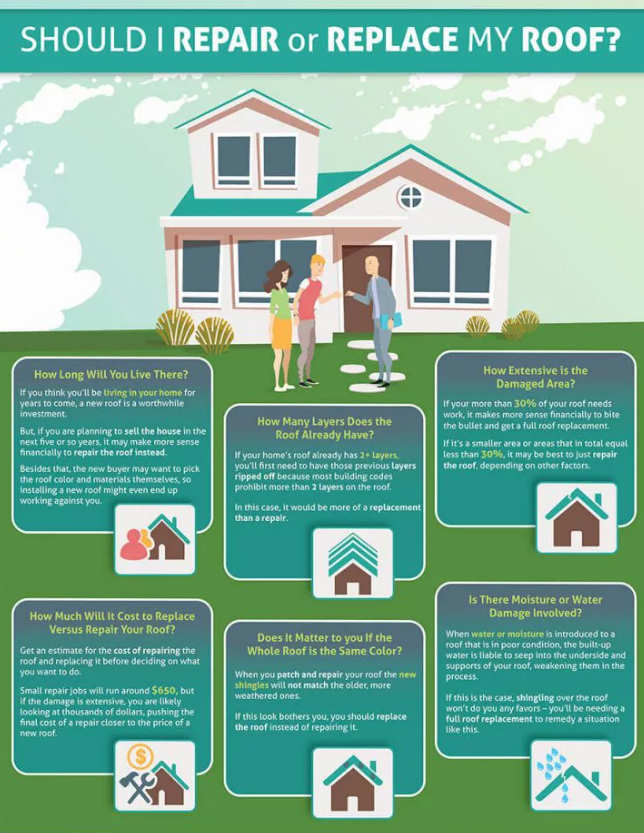
Your roof is leaking. Or you’ve got a handful of missing shingles from a winter storm. Or a section looks rough but the rest looks fine. The question every homeowner asks when we show up for an inspection: can we just repair this, or am I looking at a full replacement?
It’s the right question. Nobody wants to drop $22,000 on a replacement if a $1,500 repair will do. But nobody wants to pay $1,500 for a repair that fails next winter either. Here’s how we think about it when we’re on your roof — the real rules for roof repair vs. replace in NH, and the specific situations that push the answer one way or the other.
The Age Rule: What’s Your Roof’s Life Expectancy?
Before we even look at the damage, we ask how old the roof is. That single number often decides the answer before we climb a ladder.
- Under 10 years old: Almost always repair. Your roof should have another 15-25+ years in it, and replacement is premature.
- 10-18 years old: Repair is usually still the right call, but we pay closer attention to granule loss, curling shingles, and flashing condition elsewhere on the roof.
- 18-25 years old: Case-by-case. We look at overall roof condition, whether damage is isolated or spreading, and how much longer the homeowner plans to stay.
- 25+ years old: Replacement is usually the honest recommendation. Repairing a roof near end-of-life is throwing good money after bad — you’ll have another failure within 2-3 years.
Don’t know how old your roof is? Ask the previous owner if you bought the house, check your home inspection report, or look for the date on permits. If none of that works, we can usually estimate within 3-5 years from shingle condition.
Damage That Almost Always = Repair
If the damage is localized and the rest of the roof is sound, repair is the right call. Here’s what we mean by localized:
- A handful of wind-blown shingles. We see this after every nor’easter — especially on Seacoast homes in Rye, Hampton, and North Hampton. Six to twelve missing shingles on a 20-year roof: replace those courses, blend new shingles into the field, done. $400-$900.
- A single pipe boot failure. The rubber gasket around plumbing vents cracks around year 15. A new boot flashing is a 30-minute fix. $250-$500.
- Isolated flashing failure at a chimney or wall. Chimney flashing has a shorter life than the roof itself. Re-flashing a chimney without replacing the roof is common and cost-effective. $400-$900.
- A fallen branch puncture. One hole in one spot, caught quickly. Replace the damaged shingles, patch the decking if needed. $400-$1,200 depending on damage size.
- Ice dam shingle lift at one eave. Bad winter buckled a few courses of shingles at one eave. The rest of the roof is fine. Strip the damaged section, install new ice & water shield, re-shingle. $600-$1,500.
Damage That Almost Always = Replace
Some failures aren’t fixable as repairs — the scope is too wide or the underlying issue runs across the whole roof.
- Widespread granule loss. If your gutters are full of black shingle grit every time it rains, and you can see bare fiberglass mat on south-facing slopes, your shingles are done. Repairs won’t stop the field from failing.
- Curling or cupping across the whole roof. Shingles curl up at the corners when they reach end-of-life. If more than a quarter of your roof shows curling, the adhesive is gone and the whole field is ready to blow off in the next big wind.
- Widespread nail pops or exposed fasteners. Nails backing out through the shingle mat is a full-field installation failure. Spot-fixing won’t hold.
- Decking rot across multiple areas. If we pull up shingles for a repair and find soft, spongy decking over more than 10% of the roof, we’re going to recommend a full tear-off. Roofing over rotted decking is pointless.
- Multiple active interior leaks. One leak traced to one spot = repair. Three leaks in three different locations = systemic failure.
- Storm damage across more than 30-40% of the roof. Straight-line wind event, hail, microburst — if the damage is broad, piecemeal repairs won’t restore the roof to full service.
Quick tip: If your roof is over 20 years old AND you’re planning to sell in the next 3-5 years, replacement is usually the right call regardless of whether the current damage seems fixable. Buyers and inspectors will flag an aged roof, and you’ll either drop price or pay for a replacement during closing anyway.
The Middle Ground: When It’s a Judgment Call
Most of the inspections we run in NH land in the middle. The damage isn’t obviously one or the other. Here’s the math we walk homeowners through:
The 30% rule
If the repair cost would be more than 30% of what a full replacement costs, we usually recommend replacing. Example: $6,500 repair on a roof that would cost $22,000 to replace. You’re spending a third of replacement cost on a roof that still has limited life. Harder to justify.
The 10-year rule
If your roof has less than 10 years of realistic life left, we’re cautious about major repair work. Spending $4,000 on a roof with 5 years left means you’re paying $800/year for that repair. A full replacement amortized over 30 years of new life costs $730/year. The math flips faster than most homeowners expect.
The damage pattern
Isolated damage in one area of the roof + sound shingles elsewhere = good repair candidate. Damage spread across multiple planes, or a mix of wind damage AND age-related failure = replacement conversation.
Regional Failure Patterns Across Our Service Area
Where your home is changes what kind of damage you’re most likely to see — and changes whether repair or replace is typically the right call.
Seacoast NH (Exeter, Stratham, Portsmouth, Hampton, Dover, Rye): Wind damage is the dominant failure mode. Missing shingles after nor’easters are usually repair candidates, especially on roofs under 15 years. Salt air accelerates flashing corrosion on older oceanfront homes, which is another repair-friendly failure.
Lakes Region NH (Laconia, Meredith, Gilford, Wolfeboro, Belmont): Ice dam damage at the eaves is the most common failure we see. These repairs are usually viable if the damage is limited to one or two eaves and the rest of the roof is sound — but we often find the ice dam symptom points to a bigger ventilation problem that’s cooking the whole roof. Full attic assessment matters here.
Northern MA (Newburyport, Amesbury, Haverhill, Merrimac): Mix of wind damage, moss/algae staining, and age-related granule loss on older housing stock. Many homes here are 25+ years into their second roof. Age tips more decisions toward replacement.
Southern ME (Kittery, York, South Berwick, Eliot, Berwick): Coastal wind and salt exposure drives most repairs. Older cottages often need repair now, replacement in 5-10 years.
What a Real Repair Quote Should Include
A quick repair shouldn’t be sketchy. Even for small jobs, ask for:
- Written scope of exactly what’s being replaced
- Matching shingle spec (same manufacturer/line/color as existing, or closest available)
- Ice & water shield under the repair area if applicable
- Warranty on the workmanship (1-5 years is typical for repairs)
- Photos of the damage before and after
- Honest assessment of what the damage means for the rest of the roof
If a contractor shows up, glances at your roof, and quotes you a replacement without any discussion of whether repair is viable, get another opinion. That’s a commission conversation, not a diagnosis.
Frequently Asked Questions
How much does a typical roof repair cost in NH?
Most targeted repairs run $400-$1,500. Pipe boot replacements, missing shingles after storms, chimney re-flashing, and small leak tracing all fall in that range. Larger repairs (replacing a full eave section, multiple valleys, or extensive ice dam damage) run $2,000-$5,000.
Can I repair just one slope of my roof?
Yes, but the math usually doesn’t work for single-slope replacements unless the slopes are significantly different ages (one was replaced after storm damage, for example). Color matching new shingles to 10-year-old weathered shingles is nearly impossible, so partial replacements are often visually obvious from the street.
Will a repair void my roof warranty?
Not if done correctly by a qualified roofer. A proper repair uses matching materials and doesn’t interfere with the field installation. Sloppy repairs (wrong fasteners, missing underlayment, improper flashing) can compromise a manufacturer warranty — another reason to hire a real contractor, not a handyman.
How long will a repair last on an older roof?
A quality repair should last as long as the rest of the roof does — so if your roof has 8 years left, the repair should last 8 years. The reason repairs on old roofs feel like they “don’t last” is that the rest of the roof fails around them. The repair is still holding, but something else gives out first.
If I’m planning to sell, should I repair or replace?
Depends on timeline. Selling in under a year with a 20+ year old roof — replacement usually pays off at listing. Selling in 5+ years — repair now, replace closer to sale. A new roof is a strong selling point in NH, and buyers increasingly ask for roof age in inspection contingencies.
What if an insurance adjuster said it’s a repair but I think it should be a replacement?
Get an independent roofer’s opinion. We do retail repair and replacement work, not insurance storm-chasing, so our assessment is about what your roof actually needs — not what an insurance scope says they’ll pay for. If your roof is genuinely past its service life, we’ll tell you honestly.
What to Do Next
If you’re staring at a damaged roof wondering whether to repair or replace, we’ll come out, walk the roof in person, and give you an honest assessment. No pressure either direction — we do both, and we’ll tell you which one actually fits your situation. Call 603-219-1523 or schedule a free inspection.