
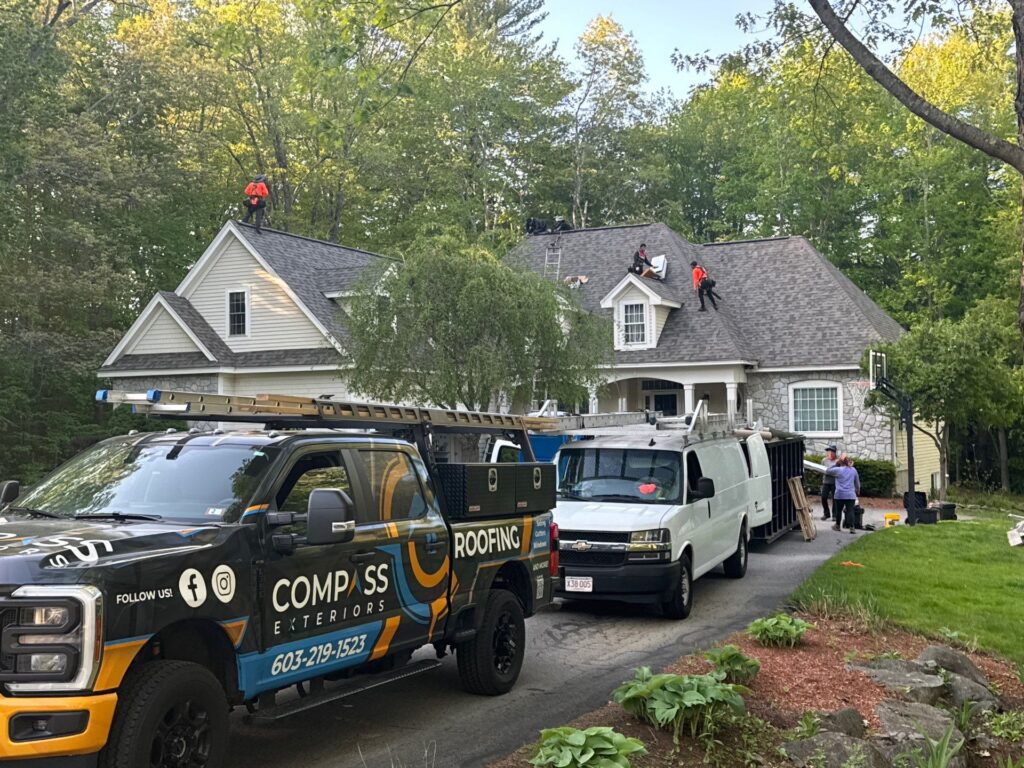
You signed the contract, picked your shingle color, and now there’s a date on the calendar. So what actually happens that morning when the truck pulls up?
Most homeowners have never watched a roof get replaced — and the ones who have usually watched from inside, listening to what sounds like a herd of elephants overhead. We get the same questions on nearly every job: How long will this take? Do I need to be home? What happens if you find something rotten under there? This is the whole thing, start to finish, the way it really runs on a New Hampshire home. No mystery, no surprises on the invoice.
A roof replacement runs in five stages — setup and protection, tear-off, decking inspection and repair, dry-in (underlayment, ice & water shield, drip edge, flashing), then shingles and cleanup. Most single-family asphalt roofs in NH are finished in one day, though steep, large, or rot-heavy roofs can take two to three.
How long does a roof replacement take?
Here’s the honest version: a clean, single-story ranch with one layer of shingles and good decking? We’re often packing up by mid-afternoon. A two-story Colonial in Exeter with a bunch of dormers, valleys, and a couple of skylights takes longer — there’s just more cutting, more flashing, more detail work. Steep pitches slow everyone down too, because the crew has to set up roof jacks and move carefully.
We won’t tear off more roof than we can dry-in and close the same day. That’s a hard rule. Opening up a deck we can’t protect before an afternoon thunderstorm rolls off the coast is how homes get water damage — so if a job needs two days, we phase it so your house is never left exposed overnight.
Stage 1: Setup and protecting your property
The crew shows up early, usually between 6:30 and 7:30 in summer to beat the afternoon heat. First thing, they stage the materials — bundles get loaded up onto the roof or staged near the house — and back the dump trailer into the driveway. That’s why we ask you to move your cars the night before.
Then comes protection. Tarps go over flower beds, along the foundation, and over anything fragile near the house. We lean sheets of plywood against the siding where the bulk of the debris is going to slide off. Decks get covered. Pools, AC condensers, patio sets — all protected or moved clear. This step is boring and it’s the one cheap contractors skip. It’s also the difference between a clean job and crushed hostas.
Stage 2: The tear-off
This is what the elephants-on-the-roof sound is. Crews work section by section with shingle forks — flat pry bars with teeth — peeling shingles, felt, and nails off in sheets and sliding them down to the trailer. On a re-roof we strip everything down to the original wood deck. We don’t shingle over an old layer, ever. Going over the top hides exactly the problems you’re paying us to find, and it voids most shingle warranties besides.
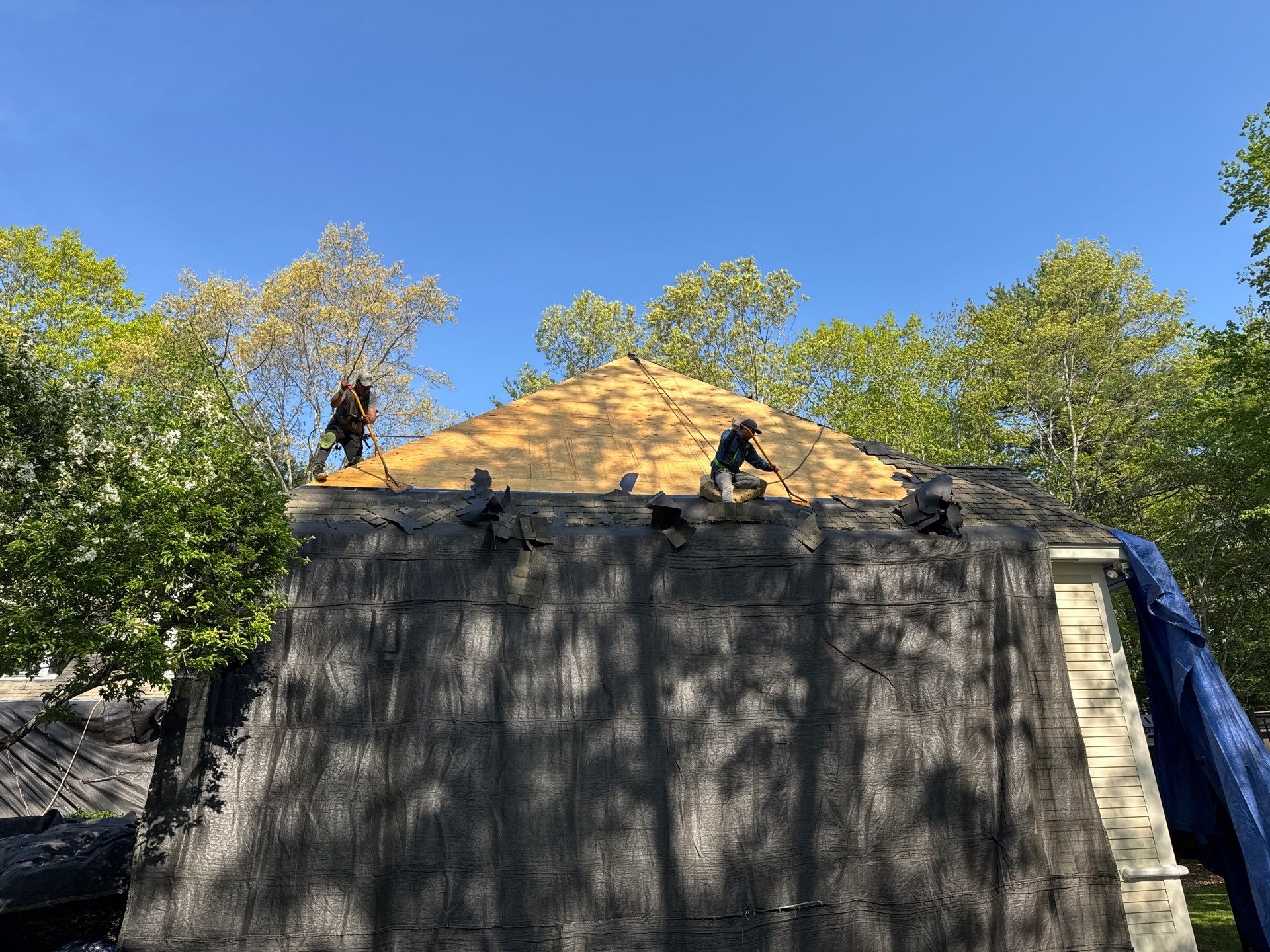
Here’s a contractor opinion you should hear: if a roofer offers to “lay new shingles right over the old ones” to save you money, walk away. A second layer traps heat, adds weight your decking wasn’t sized for, and means no one ever looked at the wood underneath. We’ve pulled up shingles on homes in Stratham and Newmarket and found sheathing so soft you could push a thumb through it — and the homeowner had no idea, because the last guy shingled right over it fifteen years ago.
Stage 3: Inspecting and replacing the decking
This is the moment you can’t get from a drone or a drive-by estimate. You only see the real condition of a roof deck after the old roof is gone. Around here the usual culprits are old leaks around chimneys and valleys, bathroom fans venting into the attic instead of outside, and plain old age on 1970s plank decking.
If we find bad decking, we show it to you or send you a photo before we cover it. Decking replacement is almost always priced as a per-sheet unit rate in your contract — commonly $70 to $120 installed per 4×8 sheet in our market — so you’re not hit with a vague lump sum. You pay for the bad sheets, not a penny more, and you see them with your own eyes first.
Ask any roofer this before you sign: “What’s your per-sheet rate for decking replacement, and will you show me the bad wood before you cover it?” A straight answer means they’ve done this right a thousand times. A dodge means they’re hoping you won’t ask.
Stage 4: Drying it in — underlayment, ice & water shield, drip edge, and flashing
People think shingles keep a roof dry. They don’t, not by themselves — they’re the armor, but the dry-in is the raincoat underneath. Here’s the order it goes down:
- Drip edge at the eaves first, so water that wicks behind the gutter gets kicked clear of the fascia.
- Ice & water shield — a self-adhering rubberized membrane — along the eaves, in the valleys, and around penetrations. New Hampshire’s climate makes this non-negotiable up the eaves to stop ice-dam backup from finding its way inside.
- Synthetic underlayment rolled over the rest of the field. We use synthetic, not old-school felt — it’s lighter, tougher, and doesn’t wrinkle or tear like 15-pound felt does.
- New flashing at every wall, chimney, skylight, and vent pipe. We install new — we don’t reuse the old bent-up stuff. Reused flashing is one of the most common sources of leaks on a “new” roof.
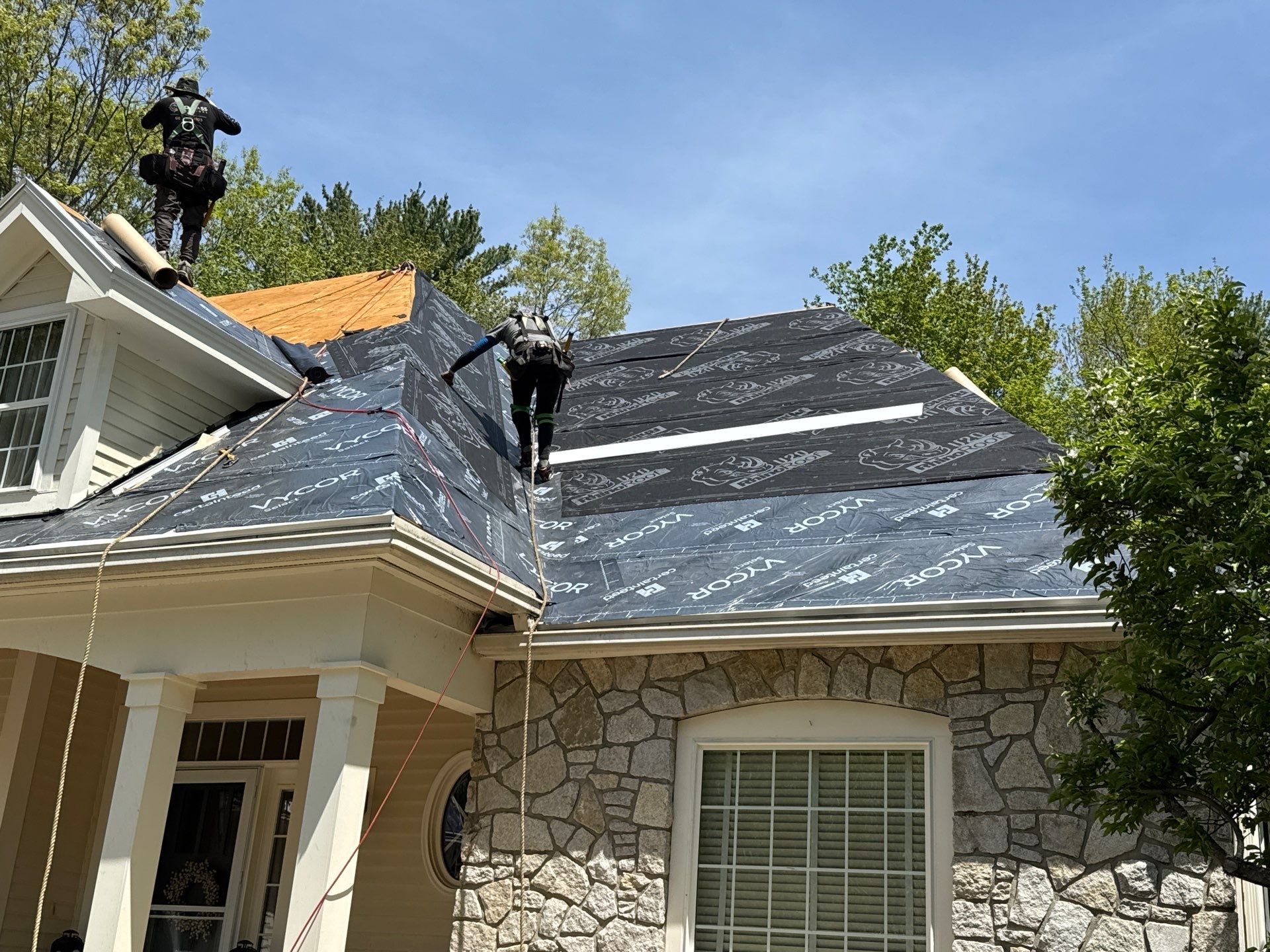
Once a section is dried in, your house is protected even if the shingles aren’t on yet. That’s the milestone that lets us breathe easy about weather.
Stage 5: Shingles, ventilation, and final cleanup
Shingles go on from the bottom up. A starter course along the eaves and rakes locks down the first row and resists wind uplift. Then the architectural shingles get laid in courses up the roof, nailed to the manufacturer’s pattern — on Owens Corning Duration shingles that means hitting the SureNail strip, which is the difference between a roof that holds its wind warranty and one that doesn’t. Valleys get woven or cut clean, penetrations get sealed, and the ridge cap caps it off.
Ventilation gets handled here too. If your attic needs it, we cut in a continuous ridge vent so hot, moist air can escape — that’s what protects the roof from the inside and keeps your shingle warranty intact. A roof with no exhaust cooks itself from below.
Then the part homeowners actually judge us on: cleanup. The trailer hauls the debris away, and we run rolling magnetic sweepers over the lawn, driveway, walkways, and flower beds — usually more than once — to pull every stray nail. Gutters get cleared of granules and debris. When we’re done, the only way you should know we were there is the new roof over your head — like the finished Exeter job at the top of this page.
The roof replacement timeline at a glance
Here’s how a typical one-day asphalt replacement breaks down on an average NH home. Bigger or more complex roofs scale up from here.
| Stage | What happens | Typical time |
|---|---|---|
| Setup & protection | Tarps, plywood guards, trailer staged, materials loaded | 45–90 min |
| Tear-off | Strip shingles, underlayment, old flashing to bare deck | 2–4 hrs |
| Decking inspection | Check every sheet; replace rotted wood | 30–90 min |
| Dry-in | Ice & water, underlayment, drip edge, new flashing | 1–2 hrs |
| Shingles & vent | Starter, field shingles, ridge vent, ridge cap | 3–5 hrs |
| Cleanup & walk-through | Haul debris, magnetic sweep, gutter clear, final inspection | 45–60 min |
Do I need to be home for it?
That said, a few people like to be home for the start so they can point out a gate code, a finicky outdoor outlet, or where the dog likes to dig under the fence. Totally fine either way. If you work from home, fair warning — tear-off morning is not the day for video calls. Plan to be on mute, or out of the house, for the loud stretch.
What a Roof Replacement Looks Like Across Our Region
Same five stages everywhere — but the climate changes what we watch for under the shingles.
Seacoast NH
Salt air off the coast corrodes old flashing and fasteners faster, so tear-offs in Portsmouth, Rye, and Hampton routinely turn up rusted nails and pitted metal. We swap in corrosion-resistant flashing and ring-shank nails as standard here.
Lakes Region NH
Freeze-thaw cycles around Laconia, Meredith, and Wolfeboro are brutal on eaves. Decking near the gutter line is the first to rot, so ice & water shield coverage well up the eave isn’t optional on these homes — it’s the whole ballgame.
Northern MA
Coastal storms off the North Shore — Newburyport, Amesbury, Haverhill — drive wind and rain under shingles. Proper starter strip and high-wind nailing patterns are what keep these roofs holding through a nor’easter.
Southern ME
York County homes in Kittery, York, and Eliot see heavy snow load plus coastal moisture. We pay extra attention to attic ventilation here, since trapped moisture rots decking from below long before the shingles wear out.
Roof Replacement FAQs
How long does a roof replacement take?
Most single-family asphalt roof replacements in NH are done in one day. A larger home, a steep or cut-up roof, multiple old layers to strip, or rotted decking can push it to two or three days. Weather is the biggest variable — we won’t open up a roof we can’t dry in and close before rain.
Do I need to be home during my roof replacement?
No. You don’t need to be home for a roof replacement. The work is entirely on the exterior. Most homeowners go to work as usual. We just ask for clear driveway access for the dump trailer and material delivery, and we’ll walk the property with you at the end if you’re around.
What happens if you find rotted decking under my shingles?
If we find rotted or delaminated decking after tear-off, we replace those sheets before any underlayment goes down. Decking replacement is usually priced per sheet (commonly $70–$120 installed per 4×8 sheet in our area) and noted in your contract as a unit rate, so you only pay for what’s actually bad — and we show you the boards before we cover them.
Will a roof replacement damage my landscaping or gutters?
It shouldn’t. Before tear-off we tarp the ground, foundation beds, and shrubs, and lean plywood against the siding where debris falls. Good crews protect AC units, decks, and walkways too. We run magnetic sweepers over the lawn, driveway, and beds at the end to pull stray nails.
What do I need to do to prepare for a roof replacement?
Move vehicles out of the driveway, take down fragile wall hangings inside (hammering vibrates the structure), and clear patio furniture or grills near the house. If you have an attic full of stored items directly under the roof deck, throw a sheet over them — fine debris can sift through between boards.
Can a roof be replaced in cold or winter weather in NH?
Yes, asphalt shingles can be installed in cold weather, but it takes more care. Shingles get brittle below about 40°F and the self-seal strips need warmth or sun to bond, so we hand-seal as needed and stage bundles to keep them workable. We’d rather schedule around a clear, milder window than fight a roof in a deep freeze.
How loud and messy is a roof replacement?
It’s loud — tear-off is the noisiest part, with scraping above and material hitting the trailer. Expect roughly 6 to 9 hours of activity on a one-day job. Mess is contained if the crew tarps properly and sweeps for nails. The yard should look the way it did before we showed up, minus the old roof.
Thinking about replacing your roof?
We’re an Owens Corning Preferred Contractor, and every estimate starts with a real, hands-on inspection — someone on a ladder looking at your actual roof, not a drone or a satellite guess. You’ll know exactly what your roof needs and what the day will look like.