
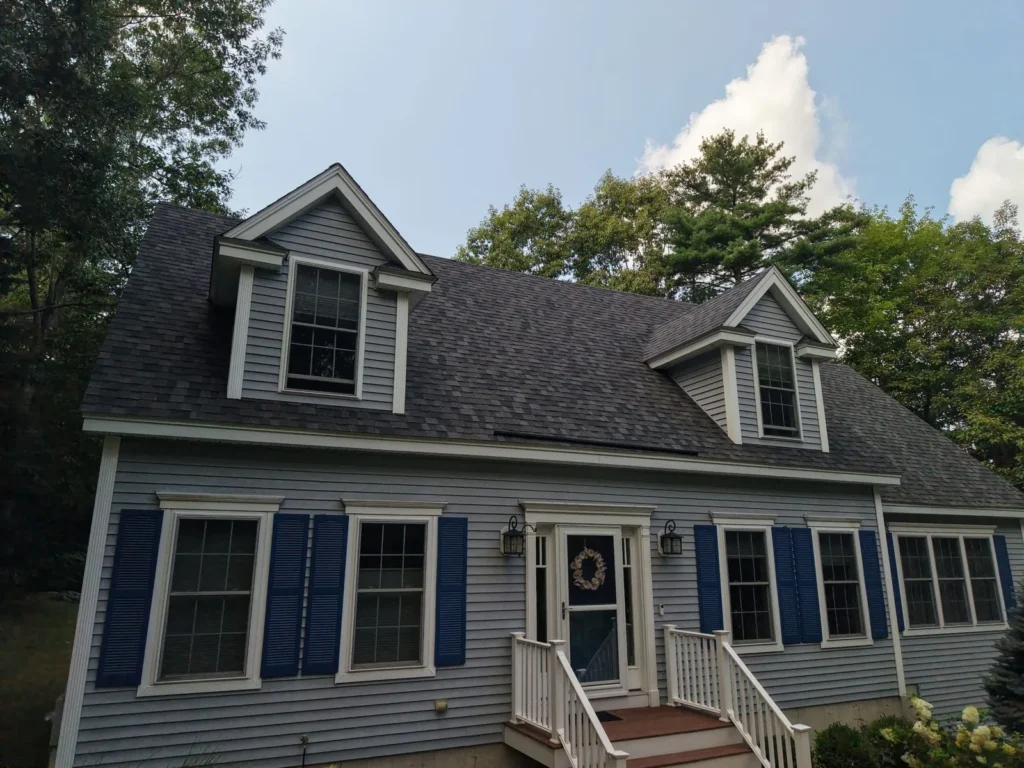
An ice dam is a ridge of ice that builds along the bottom edge of your roof. Heat leaking out of the house melts the snow up high, the water runs down, and it freezes again at the cold overhang. The fix that lasts is a cold roof deck, with ice and water shield at the eaves as backup.
Most people find out they have an ice dam from a brown ring on the bedroom ceiling. By then the water has already been through the shingles, the roof deck and the insulation.
We’re Compass Exteriors, a family-owned roofing company based in Stratham. We work across southern New Hampshire and northern Massachusetts, and every winter brings the same calls once the first real thaw hits. This page walks through what’s actually happening on your roof, what stops it, and how to tell if you need a roof replacement or just some work in the attic.
What is an ice dam, exactly?
It’s a ridge of ice at the eave that traps meltwater behind it. The water can’t drain off, so it sits there, works its way under the shingles, and leaks into the deck, the attic, and eventually your walls and ceilings.
The ice isn’t really what hurts you. The puddle behind it is. Shingles are made to shed water running downhill. They were never meant to hold back standing water, so it creeps up under the laps and finds the nail holes.
The University of Minnesota Extension’s guide to dealing with and preventing ice dams describes the same path, from the roof into the attic and down into walls and ceilings. It also warns about mold if the wet spots don’t get dried out quickly.
Why do New Hampshire roofs get so many ice dams?
Because the top of the roof is warmer than the bottom. Heat from the house gets into the attic, warms the roof deck, and melts the snow. The overhang sits outside the heated part of the house, so it stays cold and the water refreezes there.
Building Science Corporation’s digest BSD-135: Ice Dams traces the cause to a temperature difference on the roof surface, with the upper part warmer than the lower part. Every melt adds a little more ice to the ridge.
Most of that heat reaches the attic through air leaks. Warm air rises, and it finds every gap in the ceiling: recessed lights, the attic hatch, plumbing stacks, the chase around a chimney. The Department of Energy’s Building America Solution Center calls air sealing the most important step in preventing ice dams. Thin insulation is the other big one, and it’s usually thinnest right where the roof meets the outside wall, because there’s barely any room there. BSD-135 calls out that spot by name.
Ventilation matters too. A vented attic pulls cold air in at the soffits and lets it out at the ridge. Paint the soffit vents shut, or bury them under blown-in insulation, and that cold air stops moving. We wrote a whole post on why attic ventilation matters on NH roofs if you want the details.
Then there’s the weather. On the Seacoast, winter hangs around the freezing mark a lot. Snow melts on a sunny afternoon and freezes again overnight, over and over. Inland and up toward the Lakes Region you get deeper snow and longer cold stretches, so there’s more snow sitting on the roof to feed the dam. Valleys, dormers and low-pitch sections collect the most. BSD-135 even points out that the sun alone can melt snow unevenly and cause ice dams on a well-built roof. That’s the reason the eaves need a waterproof backup no matter how good your attic is.
How can you tell if ice dams are damaging your roof?
Watch for thick ice and heavy icicles at the eaves, stains or bubbling paint on upstairs ceilings and outside walls, and wet or frosty wood in the attic near the eaves. After the thaw, look for lifted shingles, stained soffits and a soft roof edge.
From the ground, a solid band of ice along the gutter line is the obvious one. A less obvious sign is a bare upper roof while the lower roof still has snow on it. That means the attic is warm enough to melt it.
Inside, check the ceilings along exterior walls on the top floor, and the trim around upstairs windows. If you can get into the attic safely, look at the underside of the roof boards near the eaves. Wet wood, frost, dark staining, or insulation that’s matted and damp along the outside walls all point the same way.
Some of the damage doesn’t show up for years. A call we get most Februaries starts with a ceiling stain near an exterior wall, usually upstairs, usually after a few days of melting. When a roof like that eventually comes off, the decking along the eaves is often soft, the underside of the boards is darker there than anywhere else, and the nails are rusted. The shingles higher up can look fine. The damage sits in the bottom few feet, right where the ice did, and often there’s no ice and water shield under it, or one narrow strip the water got past. Our post on rotted roof decking and redecking shows what that looks like.
If you’re seeing any of this, get the roof and attic looked at before next winter.
What should you do if you have an ice dam right now?
Stay off the roof. Protect the inside of the house, dry out anything wet, and write down where the water came in. Then book an inspection so the cause gets fixed, not just the drip.
Climbing up with a ladder and a hammer is the instinct, and it’s the wrong move. An icy roof is dangerous, and chopping at ice tears up the shingles you’re trying to protect. Don’t stand under big icicles either. They’re heavy and they let go without warning.
Inside, put down towels and buckets and move anything you care about out of the way. If a ceiling is bulging with water, keep everyone out from under it. Get fans or a dehumidifier going on the wet spots, since the UMN Extension guide says to dry damp areas right away to head off mold.
Take a few photos as well: the ceiling stain, the ice from the ground, the date. Knowing which room leaked, and when, saves a lot of guessing later.
The leak is the symptom. The cause is almost always heat getting into the attic, ventilation that isn’t working, missing ice and water shield, or some mix of the three. Book a free on-roof inspection and we’ll come out when it’s safe to get up there, look at the roof and the attic, and show you on video what’s going on.
What actually stops ice dams for good?
Keep the roof deck cold and give the eaves a waterproof backup. That means air sealing and insulating the attic floor, venting from the soffits to the ridge, and putting ice and water shield at the eaves and in the valleys.
Two of those jobs happen inside the attic and two happen on the roof. Air sealing and insulation are done by an insulation contractor you hire. Compass doesn’t do that work. We take care of the roof side: ventilation, ice and water shield, and flashing.
Air sealing and insulation (an insulation contractor’s job)
Sealing comes first. The Building America guide lists the usual leaks: wiring holes, recessed lights, plumbing stacks, flues, attic hatches, bath fans, the top plates of walls. Close those up and the warm, damp air stays out of the attic.
Then insulation. New Hampshire’s energy code is the 2018 IECC, per the NH Department of Energy, and it calls for R-49 in the ceiling in New Hampshire’s climate zones. ENERGY STAR’s recommended levels for adding insulation to an existing home here go up to R-60 if the attic floor has none. A lot of older New England houses aren’t close to either. The tricky spot is the eave, where the insulation has to cover the top of the wall without plugging the soffit vents.
Ventilation (the roof side)
A balanced system brings cold air in low at the soffits and lets it out high at the ridge. Baffles keep the insulation from blocking the airflow, and the Building America guide recommends at least a 2-inch air gap under the roof deck. But ventilation can’t make up for a leaky, under-insulated ceiling. BSD-135 says flat out that very low insulation levels can’t practically be offset by ventilation. You need both.
Ice and water shield (the backup)
Ice and water shield is a self-adhering, rubberized membrane that goes right on the roof deck under the shingles. It seals around every nail. It won’t stop an ice dam from forming, but it keeps the water behind the dam from getting into the house.
What about heat cables?
Heat cables can keep a channel open along the eaves so meltwater can drain. They don’t change why the dam formed, and they only work where the cable runs. Compass doesn’t sell or install them.
How much ice and water shield does a New Hampshire roof need?
Where the town requires an ice barrier, the building code says it has to run from the edge of the roof to at least 24 inches inside the exterior wall. On common pitches with a 12-inch overhang, one 3-foot roll doesn’t get you there.
New Hampshire runs on the 2024 International Residential Code, according to the New Hampshire Building Officials Association. Its ice barrier section, R905.1.2, applies where the local building department says there’s a history of ice dams, and it calls for a self-adhering membrane from the roof edge to at least 24 inches inside the exterior wall line. Your town can tell you what it requires.
That 24 inches gets measured flat across, not up the slope, and that’s where a lot of roofs come up short. Fine Homebuilding worked out how far up the slope an ice barrier has to go: with a 12-inch overhang and 2×6 walls, it’s about 47 inches on a 6/12 roof and a little over 59 inches on a 12/12. The Journal of Light Construction covers the same math in Ice Dam Membrane at Eaves, and Owens Corning’s WeatherLock installation instructions say to run it from the eaves to 24 inches inside the exterior wall.
On every roof we replace, we put down two rows of ice and water shield at the eaves and run it the full length of every valley. Two rows reach well past those numbers.
There’s one catch for older houses. The membrane goes directly on the deck, under everything else, so you can’t add it properly to a roof that’s already shingled. If yours went on with no ice and water shield, or with one skinny strip, the only real fix is to strip the eaves or replace the roof.
Will a new roof fix ice dams?
It will when the roof is part of the problem: no ice and water shield or too little, rotted decking at the eaves, no real soffit intake or ridge exhaust, or shingles that are worn out anyway. A replacement is the one time all of that can be rebuilt at once.
To be direct: If your roof is fairly young, in good shape and vented right, a new roof probably isn’t the answer. Chronic ice dams on a roof like that usually come down to the attic floor, and air sealing and insulation by an insulation contractor may be all it takes. We’ll tell you that if it’s true.
A lot of the houses we see with ice dams have a stack of problems, though. The roof is 20-some years old. It went on with little or no ice and water shield. The eave boards have soaked up water every winter for years. The soffit vents were painted over years ago, and there’s a mix of gable vents and box vents fighting each other. Patching the leak doesn’t touch any of that.
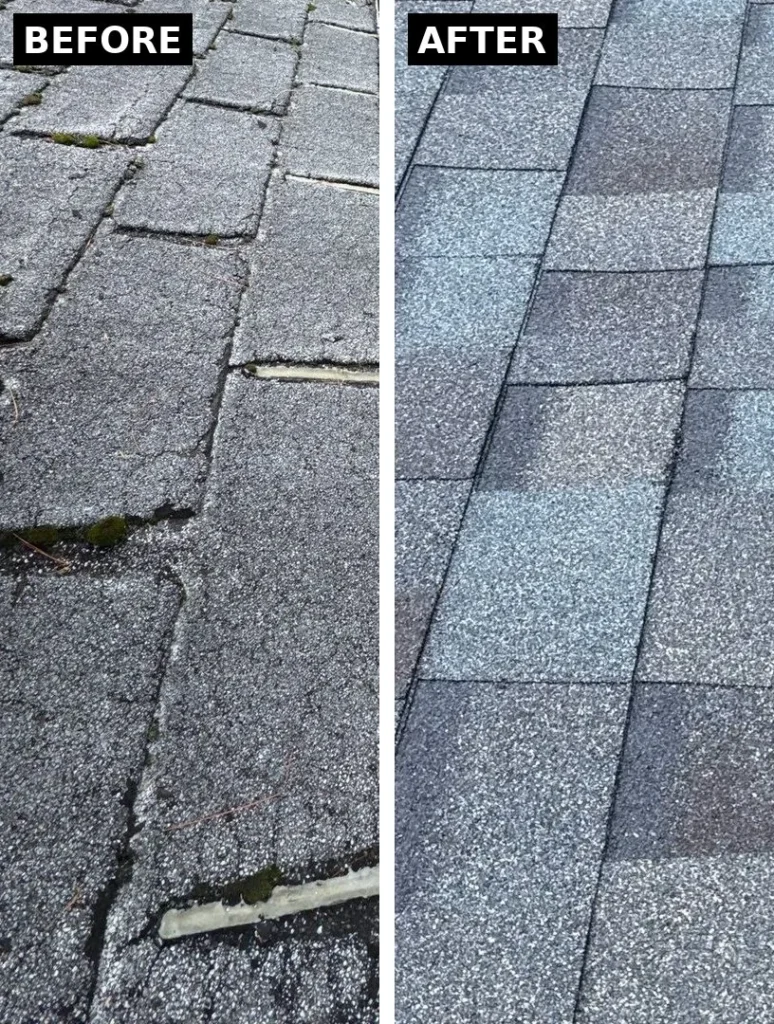
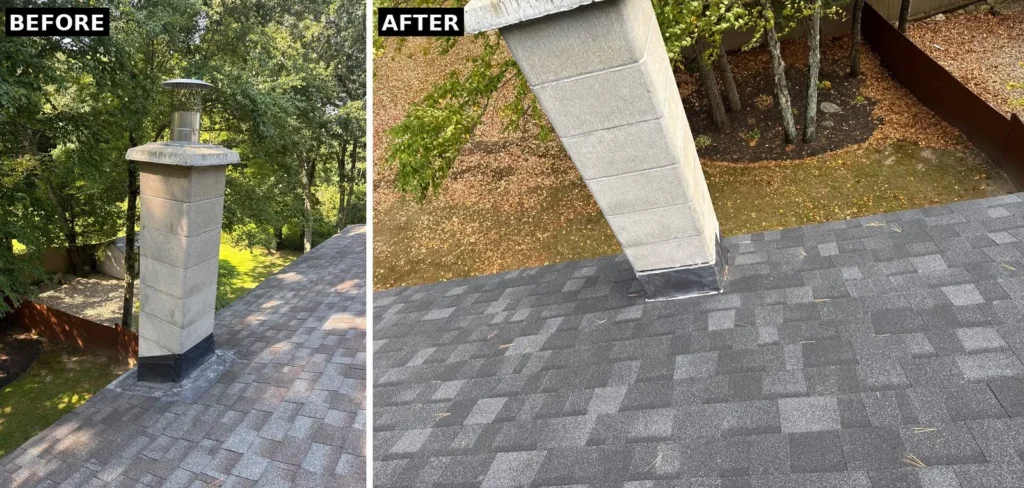
A full tear-off does. With the old roof off, we can replace every rotted board at the eaves instead of shingling over it. The two rows of ice and water shield and full valleys go down on clean, solid wood. We redesign the ventilation as one balanced system, with soffit intake, a continuous ridge vent and baffles, and we replace the flashing at chimneys, walls and pipes instead of reusing old metal. You also get a new manufacturer warranty plus our 10-year workmanship warranty in writing.
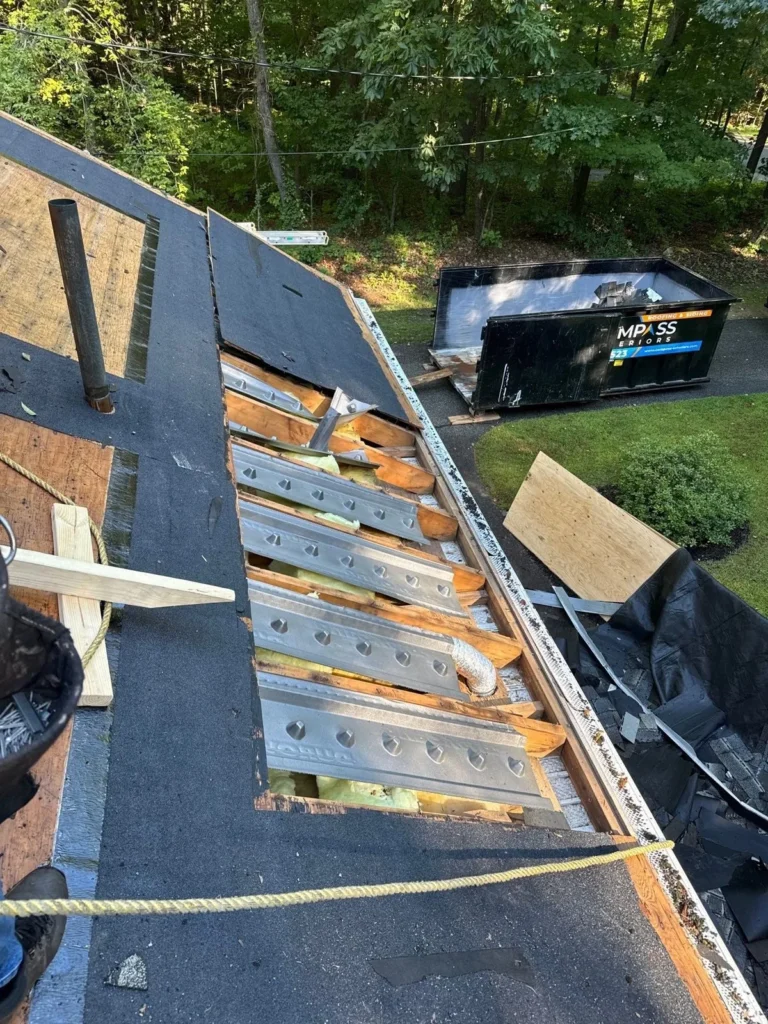
Doing it all together usually costs less, too. Ventilation and eave work is cheaper with the roof already open than as a retrofit later, and if the roof is near the end of its life you’d be paying for it twice. If the attic also needs air sealing or insulation, that’s a separate job for an insulation contractor you hire. Try to schedule it around the roof work. Our roof replacement cost guide explains what drives the price of a new roof in New Hampshire.
The pattern we see most on older homes is a roof that was patched at the eaves more than once. Each winter brings a new stain, each spring a new repair, and the underlying conditions never change. Once the deck is repaired, the ice and water shield is in place and the attic is venting properly, homeowners typically stop seeing that seasonal leak. Results still depend on the attic, which is why we’re specific about what the roof can and can’t fix.
Is a metal roof better if you fight ice dams every winter?
Often, yes. Standing seam metal sheds snow much better than shingles, so there’s less snow up there to melt and refreeze, and a metal roof lasts 50 to 70 years. You still need a well-insulated, vented attic under it. We install snow guards on metal roofs where sliding snow could hit people, doors or cars.
Snow lets go of a smooth metal roof long before it can build a thick dam, and at 50 to 70 years, metal is often the last roof the house will need. It won’t fix a hot attic, though. Low-pitch sections and shaded valleys can still ice up, so the ventilation stays in the plan when we quote metal on an ice-dam house.
A roof that sheds snow also has to send it somewhere. A whole slope can release at once, onto a front step, a deck or a parked car. We install snow guards, especially on metal roofs, to hold snow in place over walkways, entries and decks so it melts off slowly.
Still deciding? Read our asphalt vs. metal roofing in NH comparison, or see what we install on our metal roofing page.
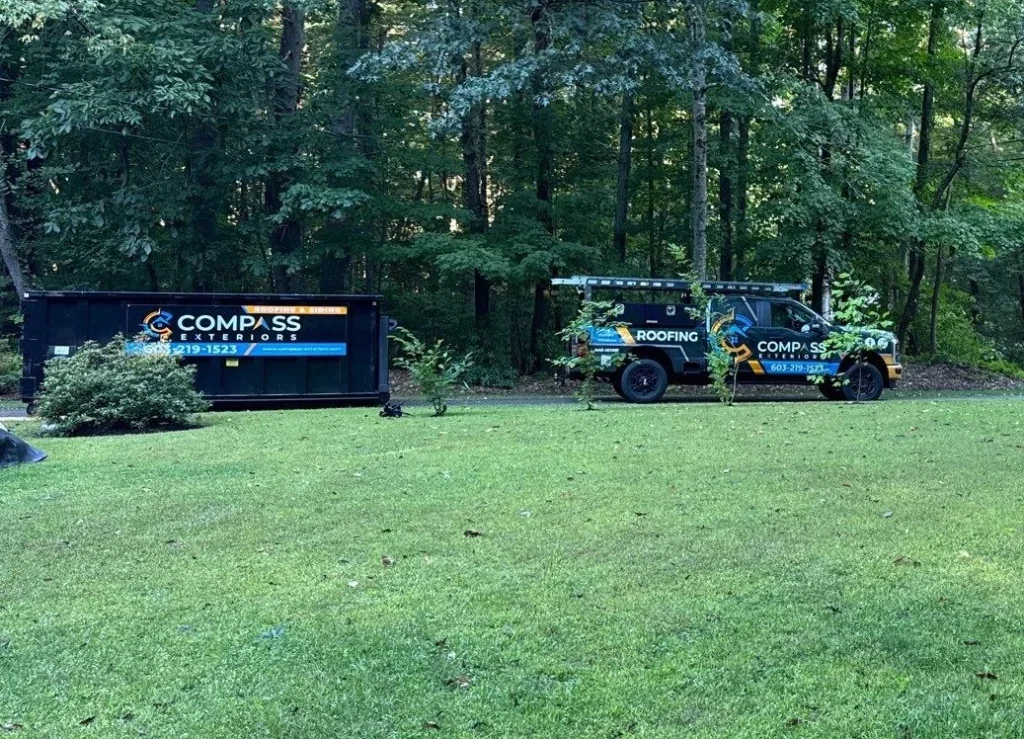
What happens when Compass inspects a house with ice dams?
We get up on the roof, look at the attic, and film it all. You get a narrated video and an itemized, fixed-price estimate that spells out what’s causing the ice dams and what it takes to fix them.
We actually climb the roof. No drive-by, no drone picture. Your rep walks the eaves, valleys, flashing and shingles with a camera running and explains what each thing means in plain language. The video is yours to keep, hire us or not.
We also check the attic: the soffit intake, the exhaust and the wood near the eaves. If the insulation looks thin, we’ll tell you it’s worth calling an insulation contractor.
The estimate lists everything line by line: decking, ice and water shield, ventilation, flashing, snow guards if you need them. No “miscellaneous.”
Most homeowners have never seen the edge of their own roof up close. On the video, the details tend to explain themselves: lifted shingles along the bottom course, staining at the drip edge, soffit vents that are painted over or blocked from the inside.
We’re an Owens Corning Preferred Contractor, licensed and insured in New Hampshire and Massachusetts, with 145+ five-star Google reviews. Our own crew does the work. If the timing is tight, financing through third-party lenders offers $0 down, 0% interest for 12 months, or terms up to 10 years if you qualify. The lender sets the terms and makes the approval call.
When’s the best time to fix an ice dam problem?
Have it looked at while the stains are fresh, then plan the work for spring through fall. If water is getting in now or the deck is soft, don’t wait. A roof can be replaced in winter on the right days.
Shingles seal best in warm weather, and spring and fall book up fast. Our post on the best time to replace a roof in NH goes season by season, including what we do differently when we have to work in the cold.
Frequently asked questions
Are icicles a sign of an ice dam?
Not always. A few small icicles after a sunny day are normal. Thick ice along the eaves with heavy icicles in the same spots every winter usually means heat is getting into the attic and melting the snow from underneath.
Will gutters or gutter guards stop ice dams?
No. Ice dams form on the roof itself, right at the cold overhang, gutter or no gutter. A clogged gutter full of ice can make things worse, but clean gutters won’t stop an ice dam if the attic is losing heat.
Does ice and water shield prevent ice dams?
No. It doesn’t stop the ice from forming. It keeps the water that backs up behind the dam from leaking through the roof deck. Preventing the dam itself means keeping the deck cold with air sealing, insulation and ventilation.
Can I add ice and water shield without replacing my roof?
Not properly. The membrane has to go directly on the roof deck under the shingles, so the roofing at the eaves has to come off first. That’s why a replacement is the time to get it right. On every replacement, Compass installs two rows at the eaves and full valleys.
Will a new roof stop ice dams?
It will when the roof is part of the problem, like missing ice and water shield, rotted eave decking or poor ventilation, because a replacement rebuilds all of that at once. If the main cause is heat leaking from the house, plan on air sealing and insulation by an insulation contractor too.
Do metal roofs get ice dams?
They can, but a lot less often. Standing seam metal sheds snow fast, so there’s less sitting on the roof to melt and refreeze. A metal roof still needs a well-insulated, vented attic. Compass installs snow guards on metal roofs where sliding snow could be a hazard.
How much insulation should a New Hampshire attic have?
New Hampshire’s energy code, the 2018 IECC, calls for R-49 in the ceiling for the state’s climate zones. ENERGY STAR recommends up to R-60 when adding insulation to an existing attic floor that has none. It should cover the tops of the outside walls without blocking the soffit vents.
Ready to stop chasing ice dams?
If you’ve had a ceiling stain after a thaw, or the same icicles in the same spots year after year, it’s worth having someone look at the roof and attic before next winter. Book a free on-roof inspection or call us at 603-219-1523. We’ll show you on video what’s causing it and give you an itemized, fixed-price estimate. Sometimes that’s a new roof with proper ventilation and ice and water shield. Sometimes it’s metal with snow guards. And sometimes it’s an honest “your roof is fine, call an insulation contractor.”
Want a ballpark number first? Hit the Instant Roof Quote button on this page.
About the author
Corey Paquette is Head of Business Operations at Compass Exteriors, a family-owned roofing and exterior company based in Stratham, NH. Compass is an Owens Corning Preferred Contractor serving homeowners across southern New Hampshire and northern Massachusetts.
Sources
- Building Science Corporation, BSD-135: Ice Dams (John Straube)
- University of Minnesota Extension, Dealing with and preventing ice dams
- U.S. DOE Building America Solution Center (PNNL), Attic Air Sealing, Insulating, and Ventilating for Ice Dam Prevention
- New Hampshire Building Officials Association, State Building Code Change – 2026
- NH Department of Energy, Energy Codes
- UpCodes, New Hampshire Energy Conservation Code 2018, Chapter 4 [RE] (Table R402.1.2)
- ENERGY STAR, Recommended Home Insulation R-Values
- Fine Homebuilding, Ice-Dam Protection: How Far Up the Roof Slope?
- Journal of Light Construction, Ice Dam Membrane at Eaves
- Owens Corning, WeatherLock Self-Sealing Ice & Water Barrier Installation Instructions (PDF)